
Species of Spaces
Christoph Gielen's aerial studies of suburban land-use patterns can be seen in the new issue of Culturehall, curated by David Andrew Frey around the theme "Future History."
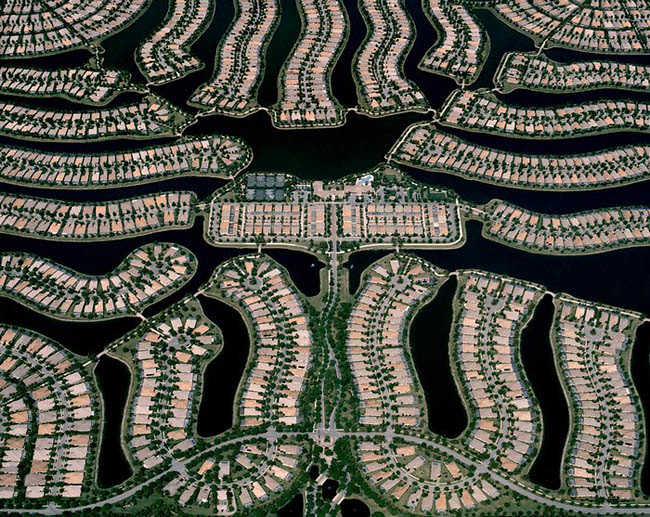 [Image: "Skye Isle II, Florida" (2009) by Christoph Gielen].
Glyphic, abstract, and typological, Gielen's chosen land forms span the multidirectional universe of ribbons in the highway structures of Southern California to kaleidoscopic rosaries of Arizona houses.
In his own words, Gielen "specializes in conducting photographic aerial studies of infrastructure in its relation to land use, exploring the intersection of art and environmental politics."
 [Image: "Untitled Arizona III" (2010) by Christoph Gielen].
The results are often stunning, as monumental earth-shields of anthropological sprawl reveal their spatial logic from above. Seemingly drab and ecologically disastrous—even intellectually stultifying—suburbs become complex geographic experiments that perhaps didn't quite go as planned.
Some of the photos—such as "Sterling Ridge VII, Florida" (2009), below—look genuinely alien, more like conceptual studies for exoplanetary settlements as imagined in the 1950s by NASA.
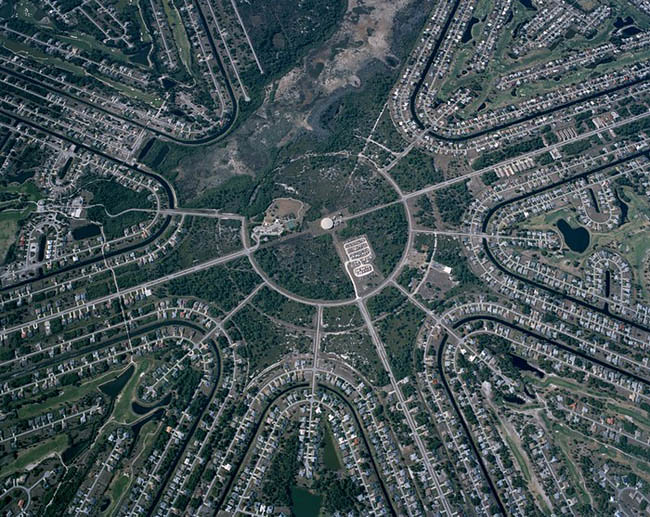 [Image: "Sterling Ridge VII, Florida" (2009) by Christoph Gielen].
How strange, though, and deeply ironic would it be for a photographic project ostensibly intended to show us how off-kilter our built environment has become—Gielen writes that "he hopes to trigger a reevaluation of our built environment, to ask: What kind of development can be considered sustainable?"—to reveal that the suburbs are, in a sense, intensely original settlement patterns tiled over the landscape in ways our species could never have anticipated? We are living amidst geometry, post-terrestrial screens between ourselves and the planet we walk upon.
[Image: "Skye Isle II, Florida" (2009) by Christoph Gielen].Glyphic, abstract, and typological, Gielen's chosen land forms span the multidirectional universe of ribbons in the highway structures of Southern California to kaleidoscopic rosaries of Arizona houses.
In his own words, Gielen "specializes in conducting photographic aerial studies of infrastructure in its relation to land use, exploring the intersection of art and environmental politics."
[Image: "Untitled Arizona III" (2010) by Christoph Gielen].The results are often stunning, as monumental earth-shields of anthropological sprawl reveal their spatial logic from above. Seemingly drab and ecologically disastrous—even intellectually stultifying—suburbs become complex geographic experiments that perhaps didn't quite go as planned.
Some of the photos—such as "Sterling Ridge VII, Florida" (2009), below—look genuinely alien, more like conceptual studies for exoplanetary settlements as imagined in the 1950s by NASA.
[Image: "Sterling Ridge VII, Florida" (2009) by Christoph Gielen].How strange, though, and deeply ironic would it be for a photographic project ostensibly intended to show us how off-kilter our built environment has become—Gielen writes that "he hopes to trigger a reevaluation of our built environment, to ask: What kind of development can be considered sustainable?"—to reveal that the suburbs are, in a sense, intensely original settlement patterns tiled over the landscape in ways our species could never have anticipated? We are living amidst geometry, post-terrestrial screens between ourselves and the planet we walk upon.


 [Image: A prison in the desert soutwest; photo by, and courtesy of,