

California City
 [Image: Geoglyphs of nowhere].
In the desert 100 miles northeast of Los Angeles is a suburb abandoned in advance of itself—the unfinished extension of a place called California City. Visible from above now are a series of badly paved streets carved into the dust and gravel, like some peculiarly American response to the Nazca Lines (or even the labyrinth at Chartres cathedral). The uninhabited street plan has become an abstract geoglyph—unintentional land art visible from airplanes—not a thriving community at all.
Take a look.
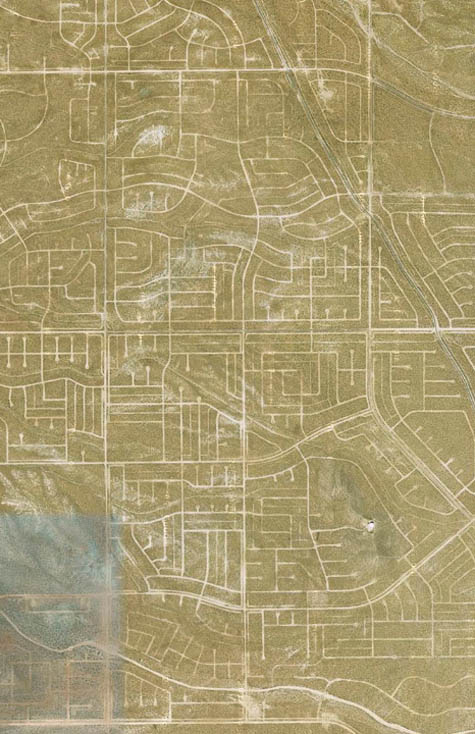 [Image: Empty streets from above, rotated 90º (north is to the right)].
On Google Street View, distant structures like McMansions can be made out here and there amidst the ghost-grid, mirages of suburbia in the middle of nowhere.
And it's a weird geography: two of the most prominent nearby landmarks include a prison—
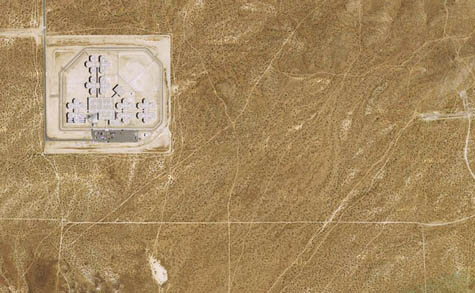 [Image: The geometry of incarceration].
—and an automobile test-driving facility run by Honda. There is also a visually spectacular boron mine to the southeast—it's the largest open-pit mine in California, according to the Center for Land Use Interpretation—and an Air Force base.
To make things slightly more surreal, in an attempt to boost its economic fortunes, California City hired actor Erik Estrada, of CHiPs fame, to act as the town's media spokesperson.
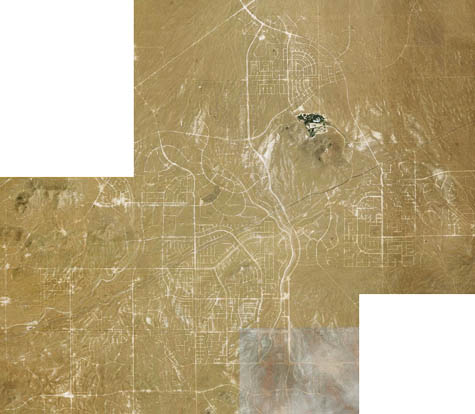 [Image: Spatial fossils of the 20th century].
The history of the town itself is of a failed Californian utopia—in fact, incredibly, if completed, it was intended to rival Los Angeles. From the city's Wikipedia entry:
- California City had its origins in 1958 when real estate developer and sociology professor Nat Mendelsohn purchased 80,000 acres (320 km2) of Mojave Desert land with the aim of master-planning California's next great city. He designed his model city, which he hoped would one day rival Los Angeles in size, around a Central Park with a 26-acre (11 ha) artificial lake. Growth did not happen anywhere close to what he expected. To this day a vast grid of crumbling paved roads, scarring vast stretches of the Mojave desert, intended to lay out residential blocks, extends well beyond the developed area of the city. A single look at satellite photos shows the extent of the scarred desert and how it stakes its claim to being California's 3rd largest geographic city, 34th largest in the US. California City was incorporated in 1965.
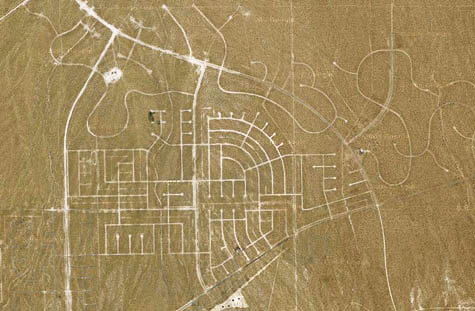
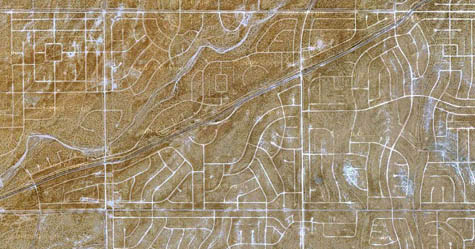
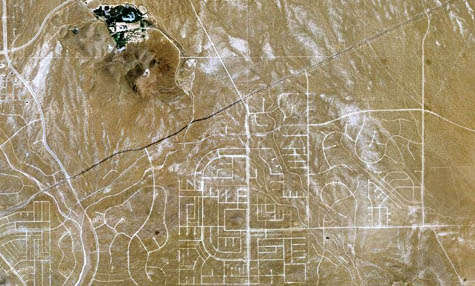 [Images: Zooming in on the derelict grid].
Either way, and with any luck, a road trip out through the deserted inscriptions of this forgotten masterplan will hopefully beckon once BLDGBLOG moves back to Los Angeles.
(California City was pointed out to me a very long time ago by




Comments are moderated.
If it's not spam, it will appear here shortly!
Don't they visit a place like this in "Generation X"?
Not quite as eerie, but equally strange is the Northwestern extents of Rio Rancho, a suburb of Albuquerque, New Mexico; miles of gridded roads stamped into the desert, predicting development that never occurred.
ha, could this be the ready-made quarantine city that we've been waiting for?
Wow this blows my mind. Great way to start the week. Thanks for the post.
Looks like Etch-A-Sketch in the California desert; the creation of giant, benevolent, dexterous thumbs.
I've seen this on Google Maps - zoom in on it and you can see that someone actually made the effort of naming all of its thousands of streets.
Their creative stamina wasn't that great, though. A single tree of cul-de-sacs near the center contains "Judy Terrace," "Judy Lane," "Judy Way," "Judy Place," "Judy Court," and "Judy Drive".
Will be interesting to see if this area is not maintained such that we can monitor how quickly and in what form the surface processes (e.g., storm runoff, redistribution of sediment, etc.) take over the landscape.
Very cool find!
See also: Deming, NM, home of Cabinetlandia.
This is incredibly fascinating. Always quite stange when physical production is ahead of specific long term thought. Thanks for the post Geoff, images are amazing.
Linda
Konrad Wachsmann's design for the California City Civic Center was way ahead of it's time and designed for to handle the massive scale of CA City. It was mentioned in Dwell a few months ago. Check it out if you are interested in technology & prefab - http://www.zinio.com/reader.jsp?issue=334027029&o=int&prev=sub&p=102
When I lived in LA, I learned to skydive at the California City ariport right next to this "development".
On the last load of the day we would often jump into it, targeting different cul de sacs and trying for accuracy. Then we'd have a couple beers at sunset and see if we could get the rovers back to the airport using the streets like a maze.
Some of the best clean fun I've had in a long time.
Wow or maybe it is government-made communication for starships lightyearing towards us with Christ on deck!
As if the weird landscape isn't enough, that prison in California City is a privately operated facility. Dystopian, indeed.
I've never come across this before—it's pretty amazing. The aerial views remind me of the veins of a dried out leaf.
Is there an obsessed doctor wandering the city's empty streets? Is there a mad pilot, and an icy woman? JGB would have loved this!
While the satelite pictures are quite impressive, your post failed to mention that more than 12,000 people actually live in California City. The "Central Park with artifical lake" actually exists, and can be seen here: http://bit.ly/7WGVDm or by simply doing a Google Maps search for California City.
Thorough research (through your credible source, Wikipedia) identifies California City as the residence of most Edwards Air Force Base employees.
Thanks, Chuck. That's why I refer to the site pictured above as an "unfinished extension" of California City.
amazing! thanks for posting this.
My grandparents used to live in California City and about 30 years ago we went there for Christmas - i must have been about 13 or 14. My Grandfather had a moped that he would let us take out for rides and I took off on it through the California City streets for about two hours. It was maybe the strangest, most desolate place I had ever been; whole city blocks with no houses on them, except here or there you would see an abandoned house - very creepy, very postapocalyptic to my impressionable young comic-book fed mind. I rode around and around (and got in trouble for staying away so long) but that place and that ride has always stayed with me; it is an almost ethereal and uniquely American ruin. I have always wanted to go back and see it again...I think my Aunt still lives there. Very cool.
Looks like a place I would love to bring a longboard to. Dang.
In 20 years from now Detroit will be another one. Already there are 10s of suburbs abandoned with crumbling houses and cracked roads. Sad to see. But, I guess, no economy survives on spending alone. The days of cheap money are over. We'll see plenty more cities like this in the future.
Interesting.
Perhaps I will move there.
I currently reside in California City. While it would seam desolate from someone that has never visited the town, it's really not all that bad. While the economy here is certainly not booming we do have numerous restaurants, and some minimal shopping. While a lot is mom & pop owned we do have a few chains; McDonalds, Rite Aid, Subway, Quiznos, and some others.
We are about 15 minutes away from a town called Mojave which is a major trucking hub that has even more restaurants, hotels, a grocery store, furniture store, and many other conveniences.
Drive another 20 minutes past Mojave and there is Lancaster & Palmdale. This is the closest Major city and has everything any major city has.
California City is a pretty decent town to live in. Sure, there are a number of empty houses within the town itself, however this adds to keeping the area a little more quite.
The biggest problem that has hit our area is the number of inner-city ghetto people that have relocated here over the past few years. This has brought crime and gang activity. Some say that our own town council went into areas like Compton and recruited these people to move here. If this is truth, it is pretty sad that they wanted to bring this element here.
Anyway, I'm now rambling.
Thanks for the interesting article. While we're not as dead of a community as you make us sound, I'm sure that could be the future here.
Anonymous, I'm not trying to put down California City, but I wouldn't call Mojave much of a major city. It's true it is a big transportation hub, but it still only has about 3500 people and a whole bunch of mothballed airplanes.
A bunch of folks from the inner city moved to the high desert in the past several years, as prices rose even in the inner city areas, and they realized that if you moved to the exurbs you could buy the American dream house for even cheaper than renting in the ghetto. Personally, I think there's nothing wrong with that.
Hello everyone...
I am a 8 years resident of California City and do not plan on going anywhere else soon. It is amazing how most of you has an opinion about our town and never even have visited... The aerial pictures could be any town from a certain altitude, so don't rely on this for a base to your opinion.
California City is only 15,000 people of the 100,000s expected by it's founder but the quality of living is far more than expected also. I went to the "Valley" (L.A.) yesterday for thanksgiving in my wife's family...and like each time I go back there I was amazed at the traffic and the pollution and could not beleive I lived there at one time. In California City, we have one signal light and are debating on the second one (not everyone approves). It takes me 45 minutes to get to a major center, but when I was in L.A., it took me the same time just to fight the traffic to get to work at half the distance! My rent in L.A. was twice my mortgage in Cal City. Here you can have a nice house, not cramped on neighbors, for a third or a fourth of one in L.A. Here, I can see the sun go up and down and see all the stars at night. I enjoy the sunny clear sky an average of 335 days a year. The bad people that came from the Valley are fewer than you think and our own Police department insure we stay as safe if not more as any other city our size.
The Second City as we call it, is the area of town that is prime desert even if streets were planned and named a long time ago, is now the mecca of off-roadders and nature campers and visitors of all kinds. On Holliday weekends like this Thanksgiving weekend, we have over a 100,000 visitors.
We have schools from kindergarden to highschool and are planning a university. I suggest you visit www.californiacity.com for a better understanding of our "little paradise in the desert".
The idea didn't turn, but that image of Geoglyphs of nowhere is some kind of genius if done on paper. Abstract art from the 1910's , way before the voids of the rothko's and choas of mondrians. Its a more playful and hopeful line, from a distance, perhaps one will find the void in abstractions if we look closer, maybe.
Great post, once again. Gets everyone in.
Kind of reminds of this place, the Salton Sea.
http://www.saltonseadocumentary.com
Google Maps has street view of the place. It's really cool; you can see how it was intended to be a huge, car-centric city.
what's interesting is that they not only planned the road layouts, they built them, which indicates they hoped for some seriously ambitious and rapid (and unrealistic?) growth! and really, the street patterns are better than what most of us get in the east coast sprawl-a-thon.
it is somewhat comical too that some plots actually did get developed. the houses are packed in tightly together with thousands of empty acres surrounding them....like fish in a bowl clustered together trying to avoid the net...
Jean Paul presents an accurate, up to date description of CalCity.
Also, Mojave isn't just home to "some mothballed airplanes", it is home to the Mojave Air and Space Port, which is the only commercial spaceport that has actually seen launch traffic (SpaceShipOne) and soon SpaceShipTwo. The airport is a bustling hive of aerospace and aviation companies who come here to be in Edwards' protected airspace for flight test.
We also have the California Portland Cement Plant, the largest windfarms in the United States and the Union Pacific Railroad, the reason for Mojave's existence.
As far as history is concerned, yes, California City was started as one of a number of Southern California land scams in the 1950s and 1960s. Lake Los Angeles is another shining example, look it up on Wikipedia.
Today, these towns are small, and offer a different kind of amenity from the big city - peace and quiet, low cost of living and wide open spaces. The kind of thing that attracts people like Jean Paul and I to live here.
Regards,
--Mike in Mojave
Started as a scam...and it could end up a space tourism port before it's done. Not a bad way for a town to evolve, come to think of it.
I recently inherited a half-acre lot on Algonquin Street that was originally purchased by my Grandparents when it all started, 1957 I think. Imagine my surprise when I then discovered that it was undeveloped desert land. Now I have to decide if I want to continue to pay the yearly taxes to Kern County in the amount of 140 dollars.
Thank you for this post. I've driven past the outskirts of this town and it truly is a surreal experience. The Mojave desert is an amazing place.
What a dump Ca City is. I went there in January to go rabbit hunting. The town is a desert garbage can...boarded up, abandoned houses, ex (or current) black gang thugs with nothing to do, and a few meth-labs, no doubt. The only thing interesting is the occasional unexploded ordnance left over from WWII training there.
what a rat hole.
There's a similar aborted development in the desert outside of Horizon City, Texas. It is quite visible on Google Maps.
Its absolutely brilliant that the neighbouring city is called the 'Second City' (via Jean Paul). I think the whole city should be reconstructed virtually and offered up to the substitute reality game Second Life. How fascinating would it be to see the myriad virtual designers, electro-builders, silicon visionaries and cyber-despots carve and create the real world which partially failed to ignite.
Free from the economic failures of the real city what kind of a place would it produce?
Although there is much I don't understand about the real estate machinations of Second Life, there could be a sale by auction after a six month virtual design and development phase. Having tested and lived in the virtual world, portions of the real world would be parcelled and sold to the highest bidder on the condition that they construct the computer generated structure.
The real world could then continue alongside the virtual world. Furthermore the virtual world could become a new way of conducting city planning. Instead of taking weeks and weeks to 'democratically' push through proposals for new buildings via a cumbersome planning process* they could be modelled, implemented and tested immediately in virtual space and put to vote by the Second Life inhabitants. Each forevermore trying to correct the other. Blurring the distinction between reality and fiction.
It would be an mind-blowing sociological experiment on the desire for utopia and the possibility of creating it. The Is-Ought problem writ large. A veritable Utopia-of-Now much akin to "Arato Isozaki's Mirage City: Another Utopia.
Of course you need a lot of billionaires to actually build the thing so us plebs can go and live there. And then everything is in their control...that is until we hack in to Second Life and change it in the virtual world so they are legally bound to reconstruct. If they can waste their money on Middle-Eastern islands in the shape of the world why don't they waste it on something they actually want?
In order to keep up with the pace of change contractors would have to construct at light speed and architects and engineers would have to specialise in detailing the impossible but, hey, according to the Bartlett, that's the kind of world we wanna live in anyway, right?
*I am talking about the UK system here. No idea what it is like in America.
**There are many reasons why this may not be the case, but for argument's sake go with me on this one
Read more about the sprawl ecosystem around L.A. in the Antelope Valley (home to Palmdale and Lancaster, near C.C.): Up Above: The Geography of Suburban Sprawl in Southern California’s Antelope Valley
It's amazing how people interpret Cal City when they've only seen it from google maps. I've lived here for 2 years and absolutely love it. It's a small, quiet, smog-free town with beautiful weather all year long.
I bought my house here for almost 1/3 the price of a house in Lancaster or Palmdale. You really can own your dream home in this town, some of the cheapest housing in CA, and the property taxes are some of the cheapest in the U.S.
It's funny when all the LA traffic comes up for the holiday weekends to bike/off-road. You know they're from LA, because they have hundreds of square miles to go camping, yet they all choose to park their quarter million dollar RV's 2 feet apart, just like a giant parking lot. Some people...
All you haters can continue to enjoy your traffic, smog infested lives in LA, bumping shoulders with people everywhere you go...I'll enjoy my peace and quite in the desert!
I had a 30 year career based upon the vision(s)of California City. At 17 I worked for California City Realty Company, which then turned into Great Western Cities, Inc. (owned by the Hunt Brothers of TX). Several years later the California City project splintered off on it's own and became Silver Saddle Ranch & Club, Inc. During these 3 decades, I lived in Los Angeles. We never gave up on the growth potential of nearby California City. Yes, it is the third largest sub-division in California and never came close to reaching it's potential. However, it is far from a Ghost Town. Mojave Air/Space Port, Edwards AFB, China Lake, etc. actually may be the springboards that will enable California City to prosper. The land sales model and private family memberships at Silver Saddle had a very good run and yes, the model as we knew it didn't come to fruition. But during those three decades, the downtown area did grow and there is a strong community and city government. The area has TREMENDOUS growth potential still and a solid infratructure that is not addressed in this blog or on the LA Times article nor on the AOL article. The people of California City (yes the number is close to 15,000) welcome growth but have also been impacted by the larger cities who shift their undesirables and discards to the desert. Feel free to visit my Silver Saddle Ranch & Club/Constellation Spa page on Facebook to see my ideas on how the existing assets can be repurposed with integrity, while prospering.- Debbie Nicastro, former Vice President of Silver Saddle Ranch & Club
I inherited 2 1/2 acres about half way between the Honda Test Track and the city. I have had numerous offers to buy it over the last 10 years. My father in law bought it under the guise that they might move LAX out there someday if it outgrew where it was! Palmdale would be the center and so my father in law paid 6 thousand for that lot; now worth about $700.; but I will hold on to it with its cheap taxes!!
Modern day California City is plagued by outlandish taxes for land that has no infrastructure to support development, (no building permits are issued without water) a real Catch 22. Especially since Cal City has had since 1958 to 1965 to get this needed infrastructure in place.
Beware of 'discount land' sellers on Ebay and elsewhere online. One such seller is apparently quite successful in duping people into buying these virtually worthless lots that he advertises using 'Everyday, more & more people just like you come to ________.com to secure their piece of the "American Dream'
Unfortunately, we too bought from this individual. Now we have land that we cannot build on yet pay over $200 a year in Kern County taxes for things that a viable, actual community provides (like water)
This 'American Dream' in Cal City exists only for these dubious shucksters, for the rest of us it is a real Nightmare.
Beware of California City.
WOW-- I dont know who created this blog but are they out of touch with reality or what? Yes, California City did not take off initially as planned, but it is thriving today....
If I could show pictures here it would be better... there is a main highway beautifully landscaped.. and expanding from the 14 to the 58 throughout the city. There are 4 brand new schools, two elementary, a middle and high school.. Cerro Coso College is commencing with phase I of their project across from the Golf Course, and there is also a PGA golf course there too. Mc Donald's Rite Aid, a few banks, the Dollar Store, Ace Hardware, a brand new Best Western Hotel, etc. are in town.... AND Caifornia City Studios is near the 14
What does someone mean that there is nothing but deserted desert here. In 2009 when this blog was written, many of these things were already in town.. some has been added, and the city projection is that this is to be a fully mature city within the next 15 years.
It blogges my mind that someone who write this blog.. Clearly they never went there because if they did they would have seen that in 2007 there was a lot of development going on in town as well as near the silver saddle country club in what is known as the second city, Beautiful homes are being built in the area.
Did I fail to mention that Strata Equity Group which created Cal State San Marcos in 1995 has bought and has plans out for environmental studies to build a new Cal State Campus at the 58 and 14.... that will be a greater demand for services from this city? That plan is to be completed by 2025, only 13 years away..
Development is slow... but things are happening in this town. It is a breathe of fresh air from LA that is for sure... and NO TRAFFIC issues!
Anonymous, I've actually been to California City, but you might note that I refer to this as "the unfinished extension of a place called California City," not California City's downtown. In fact, anyone can see for themselves from Google Maps that there is a functioning downtown area, complete with schools, shops, etc., but that it is surrounded by an absolutely vast halo of never-inhabited streets that are, today, very popular with ATV enthusiasts. It is not "out of touch with reality" to point out what is very obviously real and visible on an easy day trip from Los Angeles.
I live on the western edge of Cal City. It's about 9 miles to the town center. The central park and lake and golf course that surround them are quite nice, actually. And there are some good housing developments surrounding them. The further you get away from that area, the more barren and dystopian Cal City becomes. A planned community with no actual planning (other than street grids) beyond the central core.
I bought 5 acres in California City. If your an investor make sure you buy at a 1/4 of the valued price or less. If you purchase in the desert area-Its true, you will have virtually worthless property. Someone said its paradise..Umm well you can find some meth heads, a bunch of religious zealot signs in yards, and some basically down trodden areas. The desert is beautiful but the county said I cannot build anything on my land without paying them for water. This is a political scam. They charge $60 per foot and then say they will not bring it until you get neighbors to agree that they want the road there so that you can gain access to your property.
In other words make sure you have legal access for the land NO EXCEPTIONS- The county sometimes answers right away and sometimes it takes weeks. The avg well depth is 500 feet deep. You cant even put a mobile home on your own property that you bought. Even if you bring your own water -water tower. Its pure BS- American Dream haaa! It is indeed not! what right do you have to sell land that cannot be used? More importantly land that allegedly we dont have access to. And even if we do you tell a person your charging taxes that they cannot stay on the property they bought...California City maybe a safe haven for some but the dreams i had were like the 1958 dreams and I quickly realized why the city is not successful.
I salute those who have been residing (living in a desent life) in this City for years & years! I believe if nobody will start the community & nobody will start the business,... people or maybe the next generation will not have idea on planning to invest & have their family stay for good. The government should bring out better ideas/ more business opportunity so more people eventually consider residing in such a FUTURE ONE OF THE BEST PLACE TO ENJOY!
Long time ago, I believe that's how almost all other cities started >>> EMPTY SPACE! However, if job offers are good, electricity, water, roads, etc. are all accessible to all future residence, there's no reason for people not to consider investing & growing there family in such a place.
A town where women ride dirt bikes and beat up their boyfriends. Best be on good behavior when passing through.
Anonymous... You should research your material a little better... It is obvious that you haven't been to California City and talked to residents...
California City is a paradise for most people living here after living anywhere else...
Post a Comment