|
|
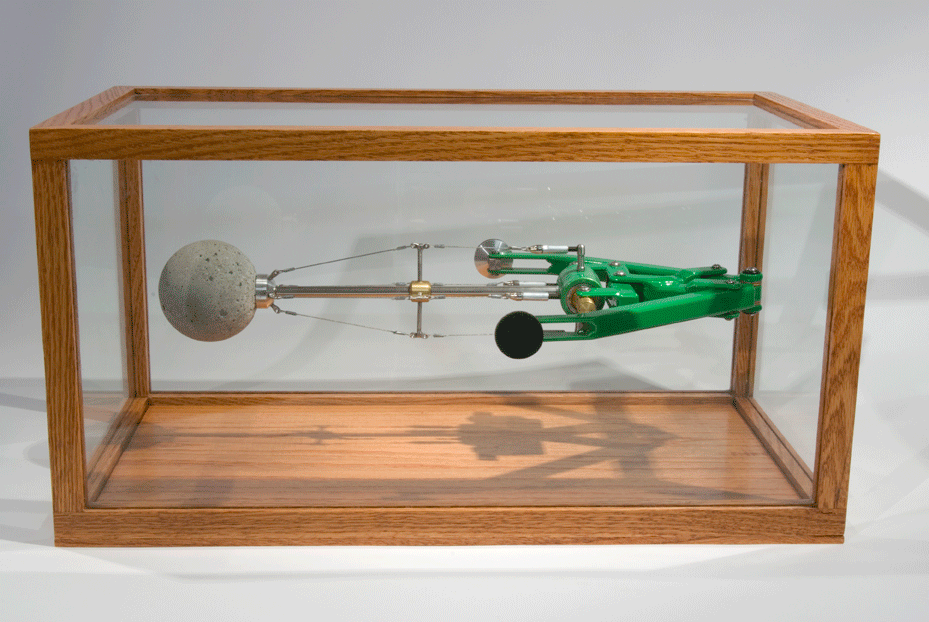
 [Image: "Cavity Mechanism #12 w/ Glass Dome" (2013) by Dan Grayber].
We've looked at the work of Bay Area sculptor Dan Grayber here before, but he's got a small show of new work opening up at Oakland's Johansson Projects gallery next month and it seems worth stopping by.
 [Image: Another view of "Cavity Mechanism #12 w/ Glass Dome" (2013) by Dan Grayber].
Grayber describes his work as a study in "self-resolving problems," where highly-tensioned devices hold themselves aloft inside glass vitrines, as if floating in space, fighting their own weight while pushing relentlessly against the walls that contain them.
  [Images: "Cavity Mechanism #9 w/ Glass Dome" (2013) by Dan Grayber].
Graybar uses an over-arching description for many of pieces seen here, writing, for example, that each piece is "a counterweight driven mechanism that wedges itself into the inside of a cavity (the glass dome in this case), suspending itself."
 [Image: "Cavity Mechanism #11 w/ Glass Dome" (2013) by Dan Grayber].
They are as much displays of gravitational potential energy—like staged moments in some avant-garde machine-ballet whose only plot and purpose is to resist the pull of the earth—as they are "art objects."
  [Images: "Cavity Mechanism #10 w/ Glass Dome" (2013) by Dan Grayber].
While the highly contained, desktop scale of each piece adds to the overall feel of pent-up force and concentration, it's hard not to want to see this guy working at Richard Serra-like proportions, scaled-up to the point of architecture.
 [Image: "Display Case Mechanism #1" (2013) by Dan Grayber].
You walk into Madison Square Park in Manhattan only to see a giant steel mantis weighing five or six tons, painted in fluorescent construction orange, poised kite-like inside a polarized glass dome, holding boulders the size of Fiats, sprung, tensioned, and impossibly buoyant, as if somehow lighter than air.
 [Image: "Cavity Mechanism #7 w/ Glass Dome" (2013) by Dan Grayber].
There is an artist's reception and opening on October 4, so mark your calendars ahead of time and stop in to meet the machines. More examples of his work can be seen here on BLDGBLOG or at the artist's own website.
In response to a description featured in an earlier post about " space truffles," designer (and occasional photographer) Nick Foster pointed me to the video featured below. Originally released last year from the Vitra Design Museum, it documents a 2012 collaboration between Studio Wieki Somers and German chocolatier Rafael Mutter.
What appears simply to be a massive column of chocolate turns out, when shaved down over time—reduced millimeter by millimeter for hours—to have countless, stunning internal geometric patterns marbled and embedded throughout its previously unseen interior. Every turn of the mill reveals more, deeper patterns; every pattern is scraped away to reveal ever deeper shapes.
Objects that only reveal themselves through reduction—or, rather, objects that reveal infinitely different, all but unrecognizable versions of themselves as they are diminished in size or shape—are a particularly fascinating thing to think about.
From genetically modified trees whose inner rings are actually precise 3D objects only revealed when the tree is sliced in section—perhaps like something out of the work of Sascha Pohflepp, where grown machines emerge like fruit from trees—to multi-course meals where each course is somehow embedded within the course that preceded it, there is a bewildering amount of future design possibility in the field.
(Thanks, Nick, for the tip!)
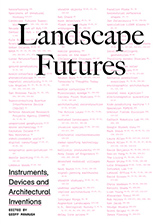
 [Image: Internal title page from Landscape Futures; book design by Everything-Type-Company].
At long last, after a delay from the printer, Landscape Futures: Instruments, Devices and Architectural Inventions is finally out and shipping internationally.
I am incredibly excited about the book, to be honest, and about the huge variety of content it features. It includes original essays by Sam Jacob, Cassim Shepard, and Elizabeth Ellsworth & Jamie Kruse of Smudge Studio; a short piece of dredge-themed landscape fiction by Pushcart Prize-winning author Scott Geiger; and a readymade course outline—open for anyone looking to teach a course on oceanographic instrumentation—by Mammoth's Rob Holmes.
These join reprints of classic texts by geologist Jan Zalasiewicz, on the incipient fossilization of our cities 100 million years from now; a look at the perverse history of weather warfare and the possibility of planetary-scale climate manipulation by James Fleming; and a brilliant analysis of the Temple of Dendur, currently held deep in the controlled atmosphere of New York's Metropolitan Museum of Art, and its implications for architectural preservation elsewhere.
And even these are complemented by an urban hiking tour by the Center for Land Use Interpretation that takes you up into the hills of Los Angeles to visit check dams, debris basins, radio antennas, and cell phone towers, and a series of ultra-short stories set in a Chicago yet to come by Pruned's Alexander Trevi.
    [Images: A few spreads from the "Landscape Futures Sourcebook" featured in Landscape Futures; book design by Everything-Type-Company].
Of course, everything just listed supplements and expands on the heart of the book, which documents the eponymous exhibition hosted at the Nevada Museum of Art, featuring specially commissioned work by Smout Allen, David Gissen, and The Living, and pre-existing work by Liam Young, Chris Woebken & Kenichi Okada, and Lateral Office.
Extensive original interviews with the exhibiting architects and designers, and a long curator's essay—describing the exhibition's focus on the intermediary devices, instruments, and spatial machines that can fundamentally transform how human beings perceive and understand the landscapes around them—complete the book, in addition to hundreds of images, many maps, and an extensive use of metallic and fluorescent inks.
The book is currently only $17.97 on Amazon.com, as well, which seems like an almost unbelievable deal; now is an awesome time to buy a copy.
             [Images: Interview spreads from Landscape Futures; book design by Everything-Type-Company].
In any case, I've written about Landscape Futures here before, and an exhaustive preview of it can be seen in this earlier post.
I just wanted to put up a notice that the book is finally shipping worldwide, with a new publication date of August 2013, and I look forward to hearing what people think. Enjoy!
The previous post, looking at the possibility of an object that could be carved, whittled, and reduced infinitely, each section revealing new, fractal details, reminded me of two short films we showed several years ago at the Silver Lake Film Festival, both by architect Bradford Watson.
An over-literal description doesn't really do Watson's work justice. In the first one, embedded below, you are looking at nothing more complicated than a series of 768 sectional cuts taken through a 96-inch 2x4, after which the resulting wooden blocks were used to make black & white prints, and the prints were then played in sequence, like a flipbook. In the second film, you're watching something even more straight-forward, which is a " matched pair" of 2x4s that have been cut down, photographed, and filmed in order until there is no more 2x4 left to cut through.
And that's it.
But they're both well worth watching, if for no other reason than the sensation they give, in the first video's case, of flying forward through space, complete with weird astronomical bursts of energy shooting diagonally and comet-like across the wood grain (for example, the moment captured at 00:09-00:10).
In the second video, below, the wood seems to mimic the rings of Saturn, a planetary concentricity occasionally crossed and streaked by foreign objects (for example, see the event at 00:18-00:19 or rewatch the weird knotted prominence, like a solar storm in wood, that appears at 00:51-00:59).
It's as if the wood itself all along had been filming the sun somehow, capturing that solar exposure in wood and documenting the star whose radiation and light had helped it to grow in the first place—as if, when you slice down into something as simple as a 2x4 normally used to construct suburban houses, you can find films of the universe, weird short loops of the skies exploding, splintered by comets and solar storms.
In fact, I'm reminded of a quotation I've always liked, from a book called Earth's Magnetism in the Age of Sail by A.R.T. Jonkers: "In 1904 a young American named Andrew Ellicott Douglass started to collect tree specimens. He was not seeking a pastime to fill his hours of leisure; his motivation was purely professional. Yet he was not employed by any forestry department or timber company, and he was neither a gardener not a botanist. For decades he continued to amass chunks of wood, all because of a lingering suspicion that a tree's bark was shielding more than sap and cellulose. He was not interested in termites, or fungal parasites, or extracting new medicine from plants. Douglass was an astronomer, and he was searching for evidence of sunspots."
The idea that an astronomer seeking to study the sun would proceed by making incisions into trees, as if looking for solar fossils there—an astral forensics of the forest—is mind-bogglingly beautiful and seems also to form the poetic subtext that makes Bradford Watson's short films so captivating.
 [Image: From The Fountain, courtesy of Warner Brothers].
A few years ago in Wired, meanwhile, veteran science journalist Steve Silberman wrote about the special effects created for Darren Aronofsky's film The Fountain. Aronofsky, Silberman explained, stumbled across the photographic work of Peter Parks, "a marine biologist and photographer who lives in a 400-year-old cowshed west of London": Parks and his son run a home f/x shop based on a device they call the microzoom optical bench. Bristling with digital and film cameras, lenses, and Victorian prisms, their contraption can magnify a microliter of water up to 500,000 times or fill an Imax screen with the period at the end of this sentence. Into water they sprinkle yeast, dyes, solvents, and baby oil, along with other ingredients they decline to divulge. The secret of Parks' technique is an odd law of fluid dynamics: The less fluid you have, the more it behaves like a solid. The upshot is that Parks can make a dash of curry powder cascading toward the lens look like an onslaught of flaming meteorites. "When these images are projected on a big screen, you feel like you're looking at infinity," he says. "That's because the same forces at work in the water—gravitational effects, settlement, refractive indices—are happening in outer space." I mention this simply because it would be interesting to experiment with ultra-low-budget 2001-like astral effects using nothing but sequential shots of wood grain, with its stuttering bursts of spatial events constantly branching out from within.
 [Image: From Fabergé Fractals by Tom Beddard].
One of the perils of spending most of the summer away from blogging, I suppose, is that it's so easy to miss interesting projects. Something that made the rounds several weeks ago, and that seemed worth re-posting here anyway is this incredible series of images exploring " Fabergé fractals" by digital artist Tom Beddard.
 [Image: From Fabergé Fractals by Tom Beddard].
It's not the sci-fi stoner appeal of the fractals themselves that is so interesting about the images, however, but rather the notion of a 3D object so dense and so complicated with internal surfaces, rings of growth, and convolutedly compressed whorls that you could cut an endless array of millimeter-thin slices from it and each one would always reveal something different. A different texture, a different marbling of colors, a different and effectively unpredictable internal geometry.
   [Images: From Fabergé Fractals by Tom Beddard].
You could slice new gems from this thing forever—carving down from every side, milling from every possible angle—and always find some strange new object there before you, one that changes through reduction, always offering, no matter how small the object eventually gets, all but infinite surface area to explore.
Architecturally speaking, it would be internally infinite in plan, internally infinite in section.
  [Image: From Fabergé Fractals by Tom Beddard].
It's like a truffle—
   [Images: Sliced truffles, randomly found via Google].
—a space truffle that could be whittled and shaved down, shaped, sanded, and cut, eternally different from what it used to be at every stage of this spatial surgery.
  [Image: From Fabergé Fractals by Tom Beddard].
(Via but does it float).
 [Image: A telephone tower in Stockholm, Sweden, courtesy of the Tekniska Museet].
Trying to catch up on the huge variety of things saved over the summer while out on our most recent jaunt for Venue, I've got an awful lot of quick links, now less-than-current news items, and a few longer reads that you've no doubt seen elsewhere at this point, but I thought I'd go through and choose a few for posting.
 [Image: A telephone tower in Stockholm, Sweden, courtesy of the Tekniska Museet].
In this case, we're looking at a telephone tower in downtown Stockholm, one that stood from roughly 1887-1913, and that served at least 5,000 local phones lines—lines that take on the literal feel of a sketch or drawing as they stretch over the streets like some urban-scale loom enthroned over the city, weaving conversations together from every district. It's a cast-iron stupa through which all voices must pass.
 [Image: A telephone tower in Stockholm, Sweden, courtesy of the Tekniska Museet].
There are a few more photos available at the Tekniska Museet's Flickr set, but here is a selection of some of the most interesting—
   [Images: A telephone tower in Stockholm, Sweden, courtesy of the Tekniska Museet].
—including a street scene of people walking to or from home with this strange skeletal structure seemingly waiting for them at the end of the lane, listening and dystopian—
 [Image: A telephone tower in Stockholm, Sweden, courtesy of the Tekniska Museet].
—or this view of it blending into its urban context. It could almost pass as a cathedral or as the intimidating battlements of an unfinished electromagnetic fortress in the middle of the downtown core.
 [Image: A telephone tower in Stockholm, Sweden, courtesy of the Tekniska Museet].
The weird and invisible mysticism of the phone system is laid bare, its nervous system exposed above the roofs of Stockholm and strung up on a tower like the pelt of some rare and conquered animal, forced to host even our most inconsequential conversations.
 [Image: A telephone tower in Stockholm, Sweden, courtesy of the Tekniska Museet].

Abandoned terrapin turtles purchased 25 years ago at the height of popularity for Teenage Mutant Ninja Turtles have been harming wildlife and changing the ecological character of England's famed Lake District. Once an orbital center for the lives of poets William Wordsworth and Samuel Taylor Coleridge, the landscape is now infested with discarded pets purchased for their imaginative resemblance to kids' toys and comic book characters.
Terry Bowes, a regional zoo director interviewed by the Guardian, has become "exasperated at the routine abandonment of creatures," he explained, "that suffered the misfortune of becoming fashionable at the time of the Teenage Mutant Ninja Turtle craze."
"I was thinking what we could do about them all," Bowes told the paper, "and then I heard about another Teenage Mutant Ninja Turtle film coming out soon and steam came out of my ears. I was thinking, 'Oh no, this is only going to get worse.'"
Human ownership of changing animal species responds to the quirks of popular appeal, we read, including hit films and toy lines: "Pets are just as vulnerable to fashion as anything else, said Bowes, as we passed three enormous European eagle owls he said were abandoned by their owners after they outgrew Harry Potter, and a trio of perky meerkats he said were probably originally bought after seeing the star of the Compare the Market insurance ads." The region is an open-air zoo of animals that have escaped from popular media.
Surely, though, in a sense, this is just the latest, albeit inadvertent iteration of the infamous American Acclimatization Society, a group of literary-minded naturalists in 19th-century New York City who made it their bizarre goal to "introduce to the U.S. every bird mentioned in Shakespeare’s scripts." As Scientific American writes, "The Acclimatization Society released some hundred starlings in New York City’s Central Park in 1890 and 1891. By 1950 starlings could be found coast to coast, north past Hudson Bay and south into Mexico. Their North American numbers today top 200 million." Shakespeare, the Bible, Teenage Mutant Ninja Turtles—all cultural artifacts and unintended animal blueprints for infested landscapes yet to come.
(The recent documentary The Elephant in the Living Room is worth a view here, for anyone interested in the unforeseen—or, far more often, willfully overlooked—negative side-effects of exotic pets).
|
|