|
|
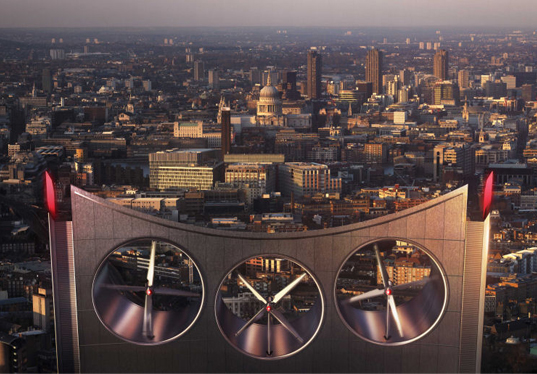 [Image: The Castle House tower by Hamiltons architects; via Inhabitat]. [Image: The Castle House tower by Hamiltons architects; via Inhabitat].Unless a "green" building actively remediates its local environment – for instance, scrubbing toxins from the air or absorbing carbon dioxide – that building is not "good" for the environment. It's simply not as bad as it could have been. Buildings aren't (yet) like huge Brita filters that you can install in a city somewhere and thus deliver pure water, cleaner air, better topsoil, or increased biodiversity to the local population. I hope buildings will do all of that someday – and some architects are already proposing such structures – but, for the most part, today's "green" buildings are simply not as bad as they could have been. A high-rise that off-sets some of its power use through the installation of rooftop wind turbines is great: it looks cool, magazine readers go crazy for it, and the building's future tenants save loads of money on electricity bills. But once you factor in these savings, something like the new Castle House eco-skyscraper still ends up being a net drain on the system. It's not good for the environment; it's just not as bad as it could have been. 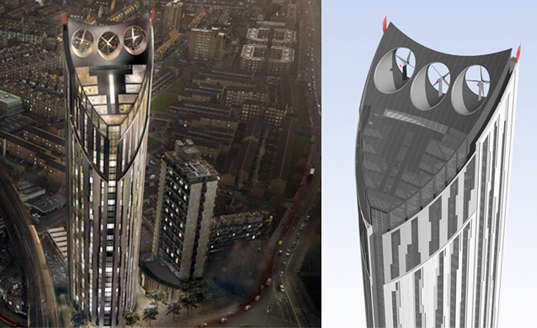 [Image: The Castle House tower by Hamiltons architects; via Inhabitat]. [Image: The Castle House tower by Hamiltons architects; via Inhabitat].My larger point, however, is that you can write about a tower that uses less structural steel, and that tower might be better for the environment than, say, a steel-intensive luxury high-rise with three rooftop wind turbines, but your article probably won't get 890 Diggs – and so you write about flashy gizmos with huge downsteam maintenance bills, instead. To use an inappropriately over-simplified example, imagine two identical 60-story high-rises. The architect of Tower A convenes his engineering team one day and they proceed to rearrange some of the building's internal structural steel; they're thus able to cut out some cantilevers, for instance, and to eliminate excess building material, more generally. This reduces the structure's embodied construction energy, by which I mean transport costs, steel manufacture, etc. A few days later, maybe the architect of Tower A even cuts out 10% of the track-lighting, or he makes the office lobbies a tiny bit smaller and, thus, easier to climate-control. The architect of Tower B makes no such changes – but he does add a wind turbine to the roof. Architect A has arguably had a much greater impact on his building's environmental bottom line – but we don't hear about Architect A. We hear about Architect B, because wind turbines look great, they are easy to explain, and they don't require much journalistic research. Architect B – who has mastered the art of ornamentalizing sustainability – comes off as a hero; Architect A, despite his accomplishments, is overlooked. Again, my point is simply that relatively unspectacular design decisions can be made in the process of constructing a building that will help lessen that building's environmental impact – but often these decisions aren't flashy. They don't photograph well, and they don't require cool new pieces of Digg-friendly technology. And so your building, however not bad it is for the environment, doesn't receive any free publicity on green building blogs. I'm not pointing fingers, either: this diagnosis is at least as true for BLDGBLOG. A relatively lame example here is Tudor residential architecture: as I mentioned back in November, Tudor-style houses are remarkably energy efficient. "Wind turbines, solar panels and other hi-tech green devices might get the media attention," I quote in that earlier post, "but the smartest way to save energy may be to live in a Tudor house and insulate the attic and repair the windows." 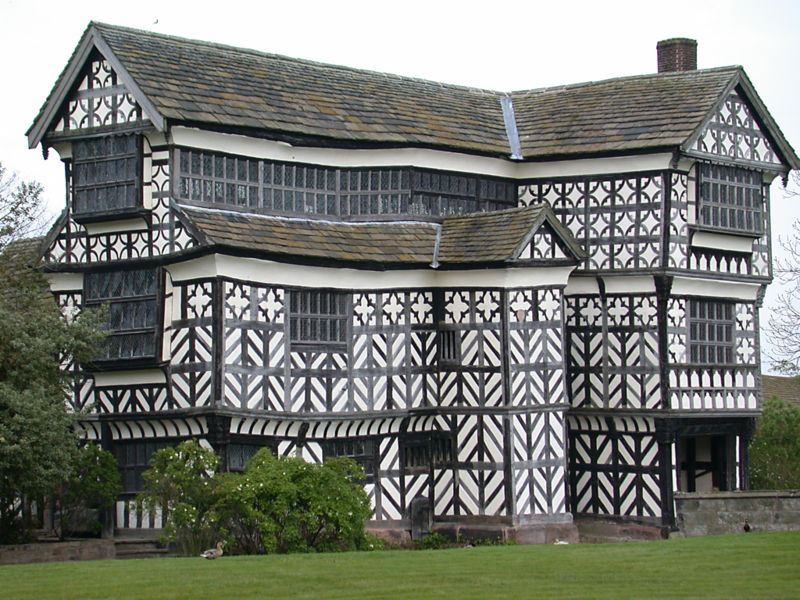 [Image: Little Moreton Hall, "an early model of energy efficiency," according to the Guardian Weekly]. [Image: Little Moreton Hall, "an early model of energy efficiency," according to the Guardian Weekly].In any case, I just think it's worth pointing out that you can compare a new building to the environmental impact of no building at all – in which case you have quite a high bar to clear before your new building is truly "green" – or you can compare that new building to how bad it might otherwise have been. If you're only doing the latter, then almost literally any minor design decision – including ornamental wind turbines or a few arbitrary solar panels – will make that building "green." In the process, "green building" slowly loses any rigor or integrity it might previously have had. Wind turbines, solar panels, rainwater catchment systems, etc., are totally awesome – I unironically endorse their architectural use – but they don't make a building good for the environment. Or at least they don't yet. They just make that building less bad for the environment than it would have been without them. Which is still great – but we shouldn't mistake restraint for generosity. In other words, we shouldn't pretend that a steel-intensive high-rise with a few wind turbines on top is somehow good for us; it's just not as bad as it could have been. I would hope that at least long-term readers know that this blog is "pro-sustainability" – I'll even sheepishly point out my own interview with Ed Mazria – but I think it's extremely important to realize that you may be building less bad high-rises, but you are still building high-rises. I remain radically unconvinced that a "green" skyscraper is better than no skyscraper at all – and yet green skyscraper enthusiasts are out high-fiving each other as if their own positive energy is enough to counteract carbon emissions from the global steel industry. This is actually one of the reasons why I like Ed Mazria and his Architecture 2030 organization so much. In a recent press release, Architecture 2030 pointed out that "the CO2 emissions from only one medium-sized (500 MW) coal-fired power plant" are enough to negate the effects of planting 300,000 trees in only ten days, among other amazing statistics – including the fact that the entire Architecture 2030 effort, as applied to building renovations, would be negated by the "CO2 emissions from just one 750 MW coal-fired power plant each year" from now till 2030. If we want to be "green," Mazria's press release implies, then a far more effective route toward that goal is to change the coal industry – not to become a luxury high-rise developer in Miami's South Beach (or, worse, in Dubai). 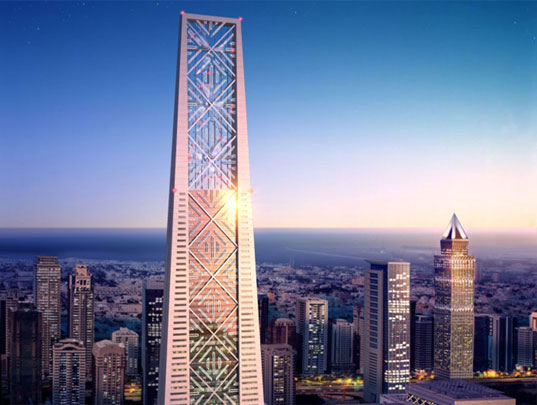 [Image: The Lighthouse, in Dubai; via Treehugger]. [Image: The Lighthouse, in Dubai; via Treehugger].Being not as bad as you could have been is not a viable future goal for sustainable architecture. Build something that genuinely improves the environment – build something that has a measurably negative carbon footprint, for instance, from the manufacture of its steel to the billing of its electricity – and then I'll be as excited as you are about how "green" the project really is. Until then, people who are only guilty of screwing the environment over partially win huge accolades: thank you, we say, for only mugging two people last night – I thought you were going to mug three... Which is positive reinforcement, sure – but it's not necessarily good for the state of architectural sustainability. (I apprehensively want to make clear that this post may have been motivated by a post at Inhabitat, but it is in no way meant as an attack on that site; I've linked to, hosted an event with, and even written several posts for Inhabitat. I also want to make clear that I am 100% behind so-called green building practices; I just don't think a "green" building should be mistaken for an environmental improvement; otherwise it's like mistaking fat-free pound cake for health food: deluded by the packaging, you eat tons of the stuff and you end up like Dom DeLuise).
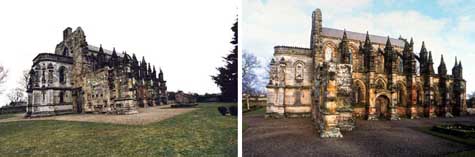 [Images: Rosslyn Chapel, container of symphonies]. [Images: Rosslyn Chapel, container of symphonies].I meant to post this ages ago – at the beginning of the summer – but it slipped right by... So this isn't exactly news, but I still love it: Scotland's Rosslyn Chapel, world famous for its appearance in Dan Brown's The Da Vinci Code, has apparently been hiding a fascinating secret, after all. It turns out that "[a] father and son who became fascinated by symbols carved into the chapel’s arches say they have deciphered a musical score encrypted in them." 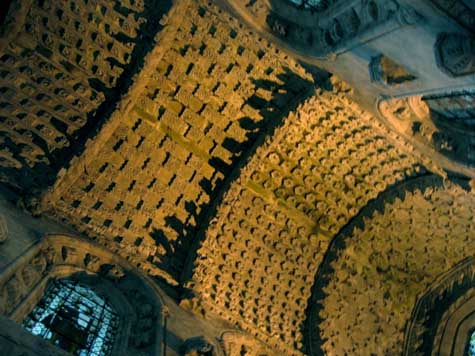 [Image: The intricate ceilingry of Rosslyn Chapel, photographed by Benjamin Lee; via Sacred Destinations]. [Image: The intricate ceilingry of Rosslyn Chapel, photographed by Benjamin Lee; via Sacred Destinations].From the website of Thomas J. Mitchell, who "decrypted" the music: "Rosslyn Chapel holds a musical mystery in its architecture and design. At one end of the chapel, on the ceiling are 4 cross-sections of arches containing elaborate symbolic designs on each array of cubes (in actual fact they are rectangles mostly). The 'cubes' are attached to the arches in a musically sequential way." In the over-ambitious application of a cryogenics metaphor, Mitchell says that the music has now "thawed out" to be understood – and heard – by people today. Being a composer, he also seems to have released the music on CD. 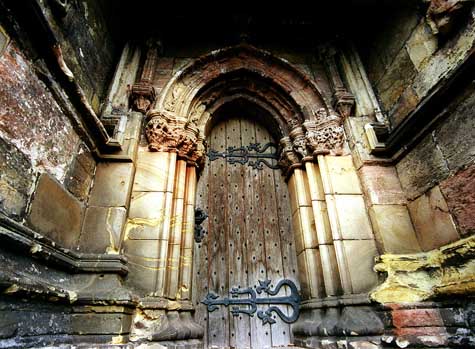 [Image: The Rosslyn Chapel doorway, photographed by seth + lara m.; via Sacred Destinations]. [Image: The Rosslyn Chapel doorway, photographed by seth + lara m.; via Sacred Destinations].Whether or not there really is music encoded in the arches of Rosslyn, the implications of this are exciting. Will someone detect, for instance, a thousand years from now, a symphony encoded in the runways at Heathrow? Or will the New York City subway system be reunderstood as a series of sub-terrestrial folk songs, themed around a chorus of transportation? Or perhaps the International Space Station will be revealed after all as an étude of pressurized air tanks, awaiting its musical decryption; it is three-dimensional music, hovering in space. (Thanks, Christopher! And happy birthday!)
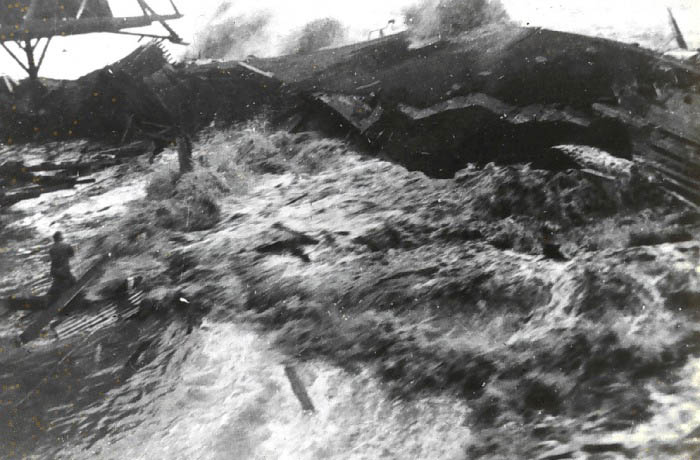 [Image: A spectator gazes out at the wave that will destroy him; via LiveScience]. [Image: A spectator gazes out at the wave that will destroy him; via LiveScience].This picture has been haunting me ever since I first saw it back in June: a man, presumably, stands on the coast of Hawaii in 1946, watching a tsunami rush to shore, bringing a wall of debris down upon him – a literal and terrifying experience of the oceanic. Caused by a massive earthquake – or catastrophic landslide – off the coast of the Aleutian Islands, the tsunami made it all the way to Hawaii, and beyond. I say earthquake or landslide because there is still some controversy over what exactly caused the wave in the first place. The Pacific Tsunami Museum, meanwhile, with an oddly titled series called the "Tsunami Survivor Video of the Month," has more general information about tidal waves in the Pacific.
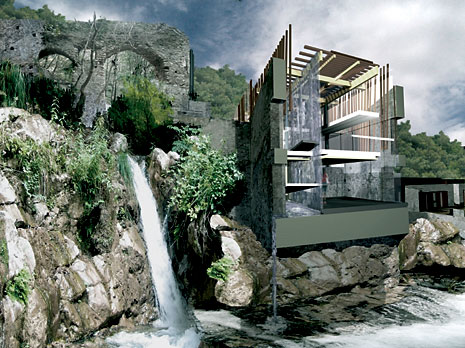 [Image: Center for Biodiversity by Tecla, part of the Waterpower project; via Domus]. [Image: Center for Biodiversity by Tecla, part of the Waterpower project; via Domus].There was an interesting, though brief, article posted on Domus last month about Italy's Valle dei Mulini, which Domus describes as "a fascinating microcosm of industrial history, dotted by abandoned paper mills." In order "to prevent this heritage from disappearing," a local planning and design group, calling itself Waterpower, "asked a series of Italian and foreign designers to make projects for the renewal of the deserted water and paper mills. There was one condition: that they take the 'power of water' as the poetic metaphor and technological guideline of their projects, turning the valley into an eco-sustainable environment." 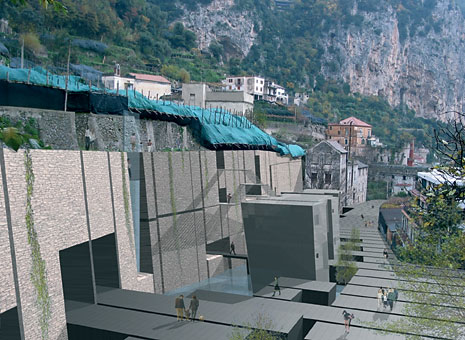 [Image: A parking garage and "river remodelling" structure by Labics, part of the Waterpower project; via Domus]. [Image: A parking garage and "river remodelling" structure by Labics, part of the Waterpower project; via Domus].The resulting proposals look at programmatically different reuses of the old mills, including purposes as diverse as a youth hostel (complete with water from the Canneto River flowing through part of the building), a Center for Biodiversity – 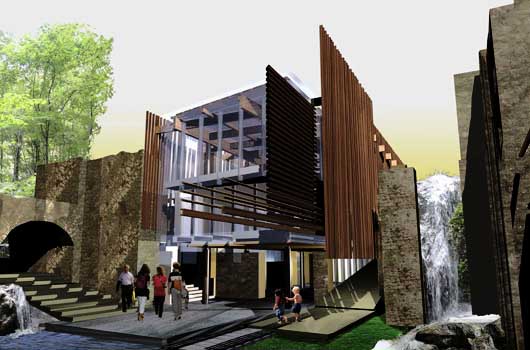 [Image: The Center for Biodiversity by Tecla, via the Waterpower project]. [Image: The Center for Biodiversity by Tecla, via the Waterpower project].– newly cultivated "lemon terraces," a spa, a kind of outdoor historical walkway, a "Waterfall Home" deeply fixed into the bedrock, complete with some kind of Slow Food studio/kitchen – 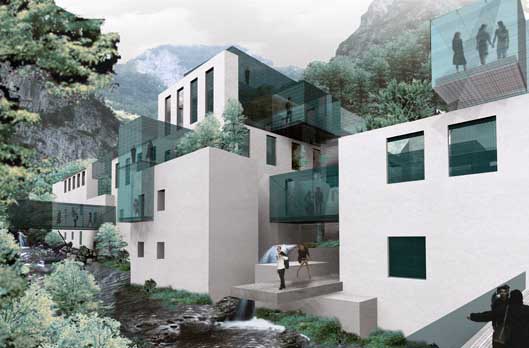 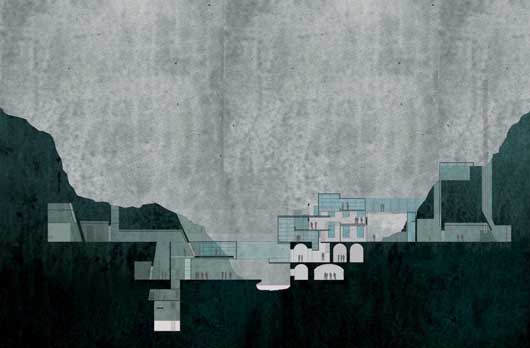 [Images: The Waterfall Home by Nemesi, via the Waterpower project]. [Images: The Waterfall Home by Nemesi, via the Waterpower project].– and a hydraulics museum. 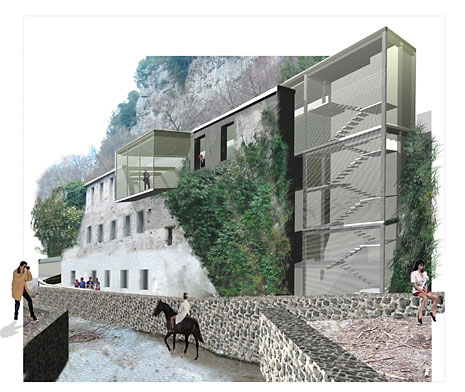 [Image: A "Hydraulics Museum & Panoramic Bar" by Sudarch, part of the Waterpower project; via Domus]. [Image: A "Hydraulics Museum & Panoramic Bar" by Sudarch, part of the Waterpower project; via Domus].The Waterpower website has a lot more information about the various projects, including a short history of the Valle dei Mulini itself. 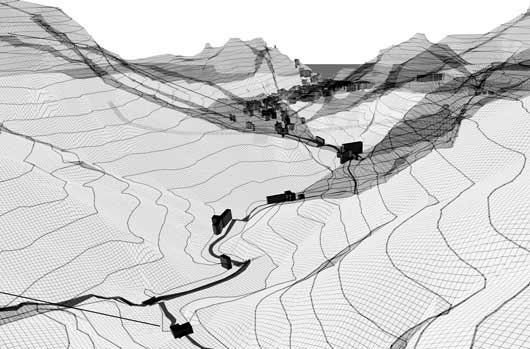 [Images: A topographical view of the Valle dei Mulini, via the Waterpower project]. [Images: A topographical view of the Valle dei Mulini, via the Waterpower project].We read, for instance, that the project "aims to recover a landscape and a system of pre-industrial water mills ( mulini) currently in danger of collapse beyond repair." As described with a wealth of illustrations in Diderot and D'Alembert's Encyclopedie, from the early 13th century the paper mills, iron mills, and later hydro-electric power stations exploited water power through ingenious systems of channels, tanks, level drops, funnels and water wheels to produce energy to make things. The mills were carefully distanced one from the next to exploit the height differential and hence the water power. From the port of Amalfi the network of mills rises 3km inland and 350m in height. It's the river valley as landscape-machine. In any case, I think it's a cool project. Read more at the official website.
I went out to meet the folks behind Planetizen last night at a rooftop party near Wilshire and Western, in L.A.'s Koreatown, to celebrate the recent publication of their new book, Contemporary Debates in Urban Planning. The book has contributions from the usual suspects in today's city planning debates, such as Joel Kotkin and Andrés Duany, and it includes a variety of short essays by other writers, critics, and practitioners, from Alex Garvin and Robert Olshansky to James Howard Kunstler, Harriet Tregoning, and Constance Beaumont. 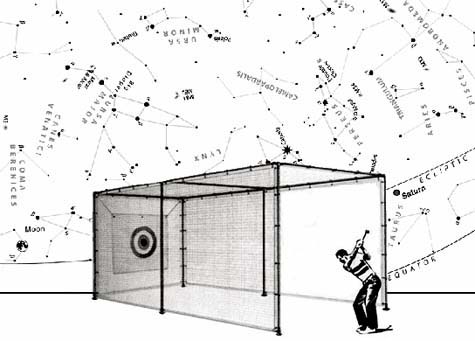 What made the night particularly memorable, however, was that I had to park several blocks away – and so, to get back to my car in the darkness, the sun having set on Los Angeles, I found myself walking past the Aroma, a multi-level indoor golf driving range, well-lit and thriving there on a Tuesday at 9pm. I looked up at the glowing structures of netting that surround the place, a soft-focus rectangle of light, nearly the size of a city block, only to see little white flashes like meteors – falling stars – streaking across the sky in front of me. Everything else was silent. Then another flash – and another – as the nets at the end of the driving range rippled with the impacts. Then more flashes. And that artificial astronomy of tiny white spheres crossing space went on and on as I walked away.
I'm excited to announce that I'll be doing a " Conversation" at the Hammer Museum here in Los Angeles on the evening of October 10, with National Book Critics Circle Award-winning, Pulitzer Prize-nominated writer Lawrence Weschler – of whom I'm a huge and long-time fan (he even spoke at Postopolis! – in fact, it was Weschler who introduced me to Walter Murch). 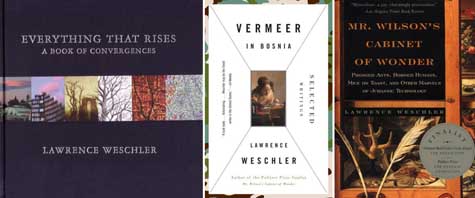 So we'll be talking, I assume, about things like cities and writing and architecture, but also about war and music and climate change, by way of science, Athanasius Kircher, contemporary politics, and – of course – Weschler's brand-new-in-paperback book Everything That Rises: A Book of Convergences. You can check out the online companion to that book over at McSweeney's. I can't wait! So if you happen to be a reader of BLDGBLOG or a fan of Lawrence Weschler, please be sure to come by – it should be a fun conversation, and who know where we'll end up. Meanwhile, I can't recommend Weschler's earlier book, Mr. Wilson's Cabinet of Wonder, highly enough (although, for the most part, it falls outside the purview of this blog); and his Vermeer in Bosnia is a great collection of essays, about everything from independence movements in Eastern Europe and Balkan genocide to furniture design, the light in Los Angeles, and the musicological history of Weschler's own family. Hopefully I'll see some of you there. Event Details: 7pm on October 10 at the Hammer Museum, 10899 Wilshire Blvd, Los Angeles, CA; free and open to the public.
BLDGBLOG's radio collaboration with DJ /rupture continues...  We're still (always!) looking for extra room fantasies – but now we're looking for field recordings, as well... field recordings by phone. So if you're anywhere that seems sonically interesting over the next few weeks – a waterfall, a migratory bird preserve, a shuddering freight elevator, the Cornish coast, a screeching Red Line train, the International Space Station, a secret meeting between Bush and Ahmadinejad – feel free to give us a ring: +1 (206) 337-1474. You'll be connected to a voicemail account where you can simply hold your phone up high – and proud – and record whatever it is that you're listening to. Meanwhile, feel free either to leave a brief explanation of what it is we're hearing, or even call back and explain what sounds you've left for us to sort through. And then the best of the best will be played live on the radio in New York City – and podcast round the world – via DJ /rupture's weekly radio show on the incomparable WFMU, 91.1 FM.  The basic idea, if you're curious, is to open up the artistic possibilities of field recordings to anyone with a telephone – whether that's a mobile phone, a public phone, or even a phone attached to the wall in your kitchen. The results should prove that you can acoustically experience a landscape through the telephone. Tele-scapes. As it is, mobile phones in particular present us with an untapped microphonic resource; these roving recorders encounter different environmental soundscapes everyday – the insides of lobbies and elevators, cars stuck in traffic, windy beaches – yet we're so busy using them for conversation that we overlook (overhear?) their true sonic possibilities. The telephonic future of environmental sound art is thus all but limitless – and putting some of that on the radio is just fun. In any case, we'll be posting many more calls for sounds soon... (For a tiny bit more info, click here).
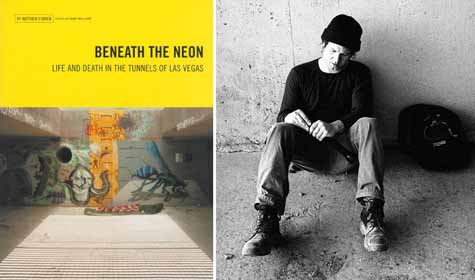 [Image: Beneath the Neon by Matthew O'Brien, with a photo of O'Brien, by Danny Mollohan]. [Image: Beneath the Neon by Matthew O'Brien, with a photo of O'Brien, by Danny Mollohan].I was intrigued to learn that Las Vegas, instant city of fast food and shrimp buffets, air-conditioning itself in the middle of the desert, actually rests upon a veritable labyrinth of flood-control tunnels, almost all of which have been constructed since 1988. This sub-desert network, literally beneath the neon of Las Vegas, is now expanding rapidly: 413 miles of new tunnels, at an estimated cost of $1.7 billion, are planned over the next 30 years. In a recent book called Beneath the Neon: Life and Death in the Tunnels of Las Vegas, author Matthew O'Brien goes down into that complex of storm-sensitive concrete waterways to document both the occasional flash flood – and the people who have taken up residence there. 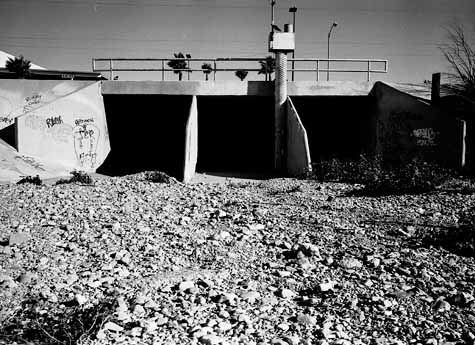 [Image: From Beneath the Neon; photo by Danny Mollohan]. [Image: From Beneath the Neon; photo by Danny Mollohan].In a brief email exchange with BLDGBLOG, O'Brien explained to me that his interest in writing the book "started with a murder." A guy named Timmy "T.J." Weber killed his girlfriend and one of her sons and raped her 14-year-old daughter. He was on the run for a week, then returned to the crime scene and attacked one of the surviving family members. The police descended on the scene – but Weber vanished. When he was caught a few weeks later in a trailer park, he told police he used a storm drain to go underneath the dragnet.
That piqued my interest. I wondered what Weber experienced in the storm drains. What he saw, what he heard, what he smelled. How, apparently without a light source, he’d splashed more than three miles upstream. I also wondered what was beneath Las Vegas. What secrets the storm drains kept. What's interesting about the book's focus is that it's motivated less by the standard tropes of urban exploration – abandonment, space, adventure, or even gonzo photography – than by a kind of anthropological interest in the people who, for a variety of complex reasons, temporarily live beneath the city. 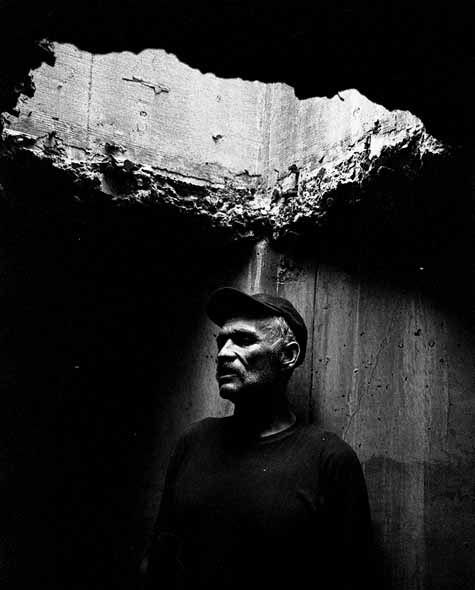 [Image: From Beneath the Neon; photo by Danny Mollohan]. [Image: From Beneath the Neon; photo by Danny Mollohan].For instance, O'Brien found that "hundreds of people – veterans, women, children – are living in the storm drains of Las Vegas, addicted to drugs and gambling, dying of diseases and getting washed away during floods." I asked him about some of the people he met down there, and he replied that "there have been several memorable experiences." Exploring a wet drain under McCarran International Airport one night, I discovered a man named Lawrence sleeping on an elevated bed. The bed, which was about four and a half feet from the floor, was made of couch cushions, a steel frame and a door that provided additional support. Baling wire looped around the head and foot of the bed, angled tightly through the manhole, and wrapped around the rungs. Backpacks hung from the side on hooks.
I squatted and swept the beam of my flashlight under the bed. It was legless. No steel poles, no wooden beams, no milk crates – nothing. A square-shaped wire dangled from the side, serving as a stepladder. Except for his bikes, the whole camp was at least three feet above the stream of urban runoff.
Lawrence told me he designed the bed after reading about mountain climbers at a local library. "This is how they sleep when they stop and rest in the middle of a climb," he explained.
Also, encountering madmen wandering around in the depths of a drain, without a light source, is something I won’t forget. That happened on a few occasions. Madwomen, too.
I stumbled on a naked man and woman smoking crack in a drain behind a Budget Suites. A man, who lived in a three-foot-in-diameter lateral pipe, washing his clothes in a stream of runoff. Street teens setting up home.
There were several experiences like this, strange but very real, most of which are detailed in the book. The book, of course, is available through Amazon, and O'Brien's ongoing reading tour, with appearances scheduled from now through November, is outlined on his blog. 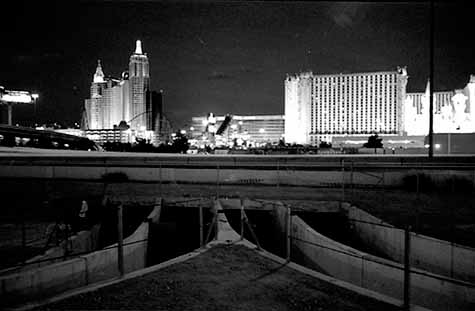 [Image: From Beneath the Neon; photo by Danny Mollohan]. [Image: From Beneath the Neon; photo by Danny Mollohan].I will say that the writing can be a little uneven at times – the dialogue, for instance, is often a bit Bill & Ted-like, which is unfortunate because the material is sociologically important enough without needing to remind us that the writer and his friends are Really Cool – but if you come across a copy, be sure to check it out! (Note: All photos in this post by Danny Mollohan. Figures for the Las Vegas Flood Control District's expansion – 413 miles of tunnel worth $1.7 billion over the next 30 years – come from Beneath the Neon).
Luke Jerram's Sky Orchestra project "explores how one can perceive an artistic experience" whilst sleeping. To do this, Jerram has "develop[ed] music specifically for sleeping people which is delivered out of the sky." 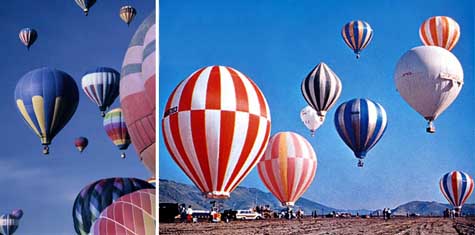 Quoting from the artist's website at length: Seven hot air balloons, each with speakers attached, take off at dawn to fly across a city. Each balloon plays a different element of the musical score creating a massive audio landscape.
"Like whales calling in the ocean, the same sounds may be heard in succession passing from one balloon to another across the sky ..."
Many hundreds of people experience the Sky Orchestra event live as the balloons fly over their homes at dawn. The airborne project is both a vast spectacular performance as well as an intimate, personal experience. The music is audible, both consciously and subconsciously, to all those in the balloon’s flight paths. Wired covered the project last summer, writing: "If you’re lulled awake by electronic music at daybreak, look up. The tune may be coming from the seven hot-air balloons in artist Luke Jerram’s Sky Orchestra as it bumps ’80s-synth-style ambient tracks from the heavens." The Telegraph jumped in, reporting that "residents of Stratford-upon-Avon awoke yesterday to find a flotilla of hot air balloons drifting over their roofs serenading them with ambient music and readings from Shakespeare." Last but not least, way back in 2004, the Guardian claimed that residents of Birmingham had been "helplessly lulled into deeper sleep at dawn yesterday morning, by specially composed music played from a flight of hot air balloons drifting over the dozing city... The flutes and oboes, bird song and whale calls, were based on scientific research to promote deeper and sweeter dreams." However, it'd be interesting to see if something like this could be abused for political purposes, whispering subliminal messages into the sleeping, pre-dawn brains of the local electorate... But it also raises an interesting paranoid-philosophical question: if you experience a particularly good night's sleep, and you live alone in the countryside somewhere, with neither witnesses nor neighbors, how do you know if the Sky Orchestra has – or has not – come floating through...? Is this how myths begin? (Huge thanks to Marilyn Terrell for pointing this out to me! Earlier on BLDGBLOG: Is that a geostationary banana in the sky – and what is it trying to say...?)
There's a great new article in New Scientist about what the surfaces of other planets – with their variable air pressure and chemical humidities – might actually sound like. Unfortunately, the article is subscriber-only, so I'll have to summarize a few of its more interesting points. 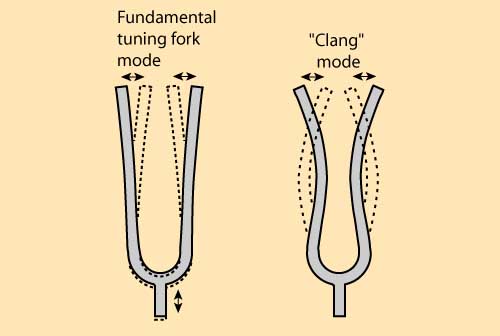 The basic trouble, the article says, is that we haven't sent microphones to many of the places we know so well visually. The Mars rovers, for instance, those wheeled landscape photographers whose work is destined to appear in tomorrow's art history textbooks, "are oblivious to the soundscape of Mars." After all, with no sensors to hear with, "they can't hear the buzz of grit whirling around in dust devils, the rumbles of Martian thunder, or even the noise of their own wheels crunching across the dusty plains." We could be listening to literally extraterrestrial soundscapes on our iPods, riding through Manhattanite subway tunnels: Imagine listening to babbling brooks of methane on Titan, or hearing deep thunder booming through Venus's dense, noxious atmosphere. Or what about the creaking and groaning of ice on Jupiter's satellite Europa, which could reveal whether the moon's frigid exterior hides a warm ocean, hospitable to life? But acoustics play second fiddle in most scientific investigations of other planets. Our heavens are silent. New Scientist points out that microphones "are usually smaller, lighter, cheaper and less power-hungry" than are cameras – imagine live-streaming the winds of Venus on your car radio, driving past Spudnuts! – but this very simplicity "may have had the adverse effect of underselling them as instruments able to deliver subtle and rich scientific information." Our sonic understanding of other planets is thus rather lacking – leaving us, more or less, to guess. Call it speculative acoustic planetology.  [Image: The canyonlands of Mars; courtesy of NASA]. [Image: The canyonlands of Mars; courtesy of NASA].So it may not immediately be obvious that things will literally sound different on other planets; but atmospheric chemistry and air pressure – or the complete lack thereof – are two major factors in the transmission of sound waves. For instance, because "Mars's atmosphere is much thinner than the Earth's – the average distance between molecules is about 120 times greater – sound waves attenuate very quickly." This has the following horror movie-like effect: While a typical scream on Earth might still be audible a kilometre away, it would only travel about 16 metres on Mars. This "low sound speed" would also "lower the pitch of your voice" – and give burgeoning screenwriters something to consider.  [Image: A stunning view of Venus, which looks more solar than planetary; courtesy of NASA]. [Image: A stunning view of Venus, which looks more solar than planetary; courtesy of NASA].On Venus, meanwhile, "sulphuric acid rains down through a CO2 atmosphere with a crushing surface pressure 90 times greater than Earth's." A Soviet lander actually brought microphones there in 1982 – picking up "deep rumbles that might have been thunder" – but we have no real idea of what Venus actually sounds like. We can speculate, however, using some kind of computer program, that "only low-frequency sounds carry well in the crushing CO2 atmosphere," nearly cutting treble altogether. It's a planet perfect for hip-hop. 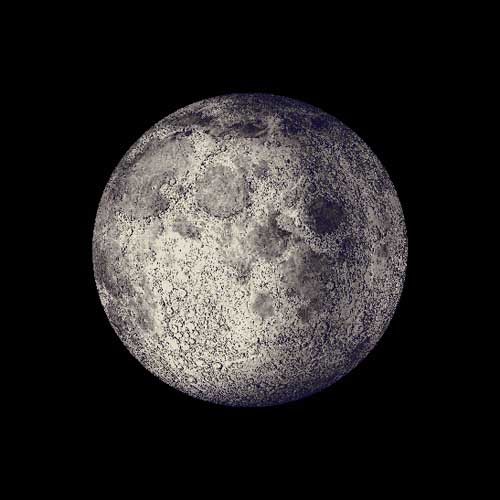 [Image: The Earth's moon]. [Image: The Earth's moon].The article goes on to explain how the crust of the Earth's moon is almost constantly groaning with "stresses and stains... due to the tidal forces of the Earth's gravity," and that there are a surprising number of "quakes triggered as heat from the sun swell[s] the moon's crust." But what do these moonquakes sound like? Titan, meanwhile, one of Saturn's moons, actually has been heard before: a microphone attached to the Huygens probe, in 2005, "recorded the whistle and whoosh" of the probe's own distant arrival. It's worth pointing out, in a brief but fascinating side-note, that drops of methane "about a centimetre wide" rain down onto the surface of Titan seven times slower than rain falls here on Earth. Imagine thunderstorms in bullet-time... In any case, Titan's atmosphere is actually "a factory for complex hydrocarbons." The sky thus has "all this photochemistry going on," one scientist is quoted as saying, with the result that Titan's surface is dotted with "dark hydrocarbon lakes" – and these lakes will probably be bubbling, we read, and each bubble will probably "pulsate like a vibrating bell" when it bursts. The acoustic effect of this would be like "having a chorus of little bubbles each 'plinking' at its own pitch," and it would all sound rather "robotic."  [Image: The cracked icy surface of Europa]. [Image: The cracked icy surface of Europa].Finally, Europa, one of Jupiter's moons and a celestial body long suspected of hosting life, is covered with a shell of ice. That ice, however, is constantly compressed by Jovian gravity, causing huge fissures and breakages – with, I'd think, spectacular, micro-continental bursts of atonality and noise. But who knows? First, we have to get a microphone there to find out. Personally, I'd love to hear music that's been deliberately tuned for alien atmospheres – slow, shuddering drones, or crystalline symphonies of accelerated acoustics. Even more, I'd love to read an acoustic analysis of different landscapes here on Earth: how far a scream propagates in the gardens of Versailles, for instance, or in the new Orange County Great Park. Or whether your voice sounds deeper in the deserts of Utah. Or whether you can unexpectedly overhear people talking far away, on some humid curve in the Parisian Seine. It's the science of acoustic planetology.
 [Note: This post was originally written for Blend – so it reads a bit like an article – though it was not actually published]. [Note: This post was originally written for Blend – so it reads a bit like an article – though it was not actually published].The company known as Muzak claims to provide "audio architecture" for its clients. Audio architecture may sound wonderful; the phrase may conjure up images of cathedrals made from noise – whole buildings connected by bridges of music – but, in the world of Muzak, it means something less exciting. Audio architecture, Muzak writes, is "the integration of music, voice and sound to create experiences designed specifically for your business." In other words, audio architecture is about making you feel comfortable – so that someone else can sell you things. The "power" of audio architecture, Muzak's website continues, "lies in its subtlety." These subtle sounds, played incessantly in the background, can "bypass the resistance of the mind and target the receptiveness of the heart." It is thus almost literally subliminal. "When people are made to feel good in, say, a store, they feel good about that store. They like it," Muzak claims. "Audio architecture builds a bridge to loyalty. And loyalty is what keeps brands alive." If there is a connection between background sounds and customer loyalty, perhaps sound could also inspire a kind of urban loyalty, where the sound of a certain city plays its own subtle role in making that place more inhabitable. Like Muzak, the city’s sound makes residents "feel good" – which "builds a bridge to [urban] loyalty." 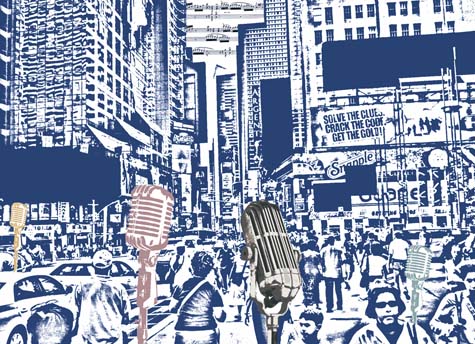 Of course, this would not be the first time someone has suggested that cities have a certain sound, unique to them, or that cities should learn to cultivate their unique sonic qualities. More than thirty years ago, the World Soundscape Project called for the " tuning" of the world. Cities would be treated as vast musical instruments: certain sounds would be eliminated altogether; others would be promoted or even subtly redesigned. The World Soundscape Project was about sonic improvement, making the world sound better, one city – one building – at a time. Where the Project went wrong, however, and where it began to act a bit like Muzak, was when it thought it had a kind of sonic monopoly over what sounded good. Industrial noises would be scrubbed from the city, for instance, and a nostalgic calm would be infused in its place. Think church bells, not automobiles. But where would such sensory cleansing leave those of us who enjoy the sounds of factories...? In any case, we could still have fun with the World Soundscape Project, designing alternative sonic futures for the cities of the world, by turning, ironically, to the techniques of Muzak itself: Muzak imitates. Rock, jazz, blues, Mozart – even Muzak: anything at all can be absorbed, and replaced, and reproduced, by Muzak. There could be a Muzak version of the street sounds of Amsterdam – played on a continuous loop in the supermarkets of London. The sounds of yesterday could be replayed today, transformed into Muzak – and Muzak versions of your old phone conversations could be broadcast over the radio... where laughter is replaced with synthesizer trills. University lectures and Books on Tape could be replaced with Muzak, pushing us toward a post-verbal society. Or we forget Muzak altogether and we simply swap urban soundtracks, cities imitating cities to sound entirely unlike themselves. In the elevators of the Empire State Building, you hear the elevators of the Eiffel Tower. The sounds of the Paris Metro are replaced with the sounds of the Beijing subway, complete with squeals from overworked brakes and the metallic thud of sliding doors. If you don’t like Rome, you can make it sound like Dubai.  In his 1964 novel Nova Express, William Burroughs described a series of elaborate, even hallucinatory, assemblages of tape recorders and microphones that could be carried from city to city. Borderless, these roving sound installations, with their capacity for instant playback, would blur the line between your own thought processes and the sounds of the city around you. Like Muzak, Burroughs's legion of rogue microphonists could thus "bypass the resistance of the mind," installing a soundtrack where there once had been thought. A few years ago I read about a sound artist who had been reproducing the exact placement of microphones used to record the live performances of orchestras around the world, only he did so in unexpected places: in the middle of rain forests, or on top of sand dunes, or in towns on the English coast and inside empty warehouses. Whether or not the story’s even true, recording the everyday noises of, say, Oslo as if Oslo is an ongoing symphony – and then re-playing that symphony through hidden speakers in San Francisco – perhaps even transforming it into Muzak – should certainly be the next artistic step. It would be a question of acoustic urban design – of true audio architecture. (Earlier on BLDGBLOG: Cover Bands of Space and Amplifier House: Original Domestic Soundscapes. See also AUDC's The Stimulus Progression).
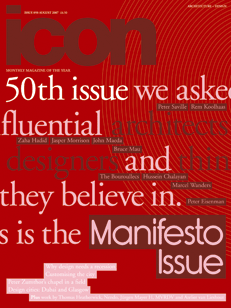 The manifestos that I posted about last week are now online at Icon: 50 manifestos for a 50th issue. So click on over and read manifestos by Rem Koolhaas ("Europe is doing almost ridiculously well. We fly for next to nothing, we have the highest quality prisons, Europe gave us millions of new friends, Frisian Lakes are maintained in order, sewers that ruined the most beautiful beaches are gone, the Spanish countryside is now a polished backdrop for whizzing high-speed trains") and Bruce Mau("So long as architects self-marginalise by purposely excluding the business of development and its real burden of complexity and decision making from their education, from their business, architecture will remain a gentleman’s weekend culture, unwilling or unable to take on the heavy lifting and big problems, happy to polish fancy baubles for our urban entertainment") and Sam Jacob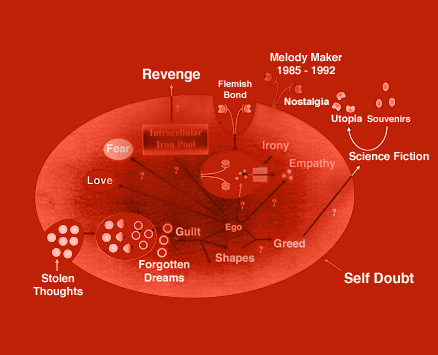 and a press release by Joshua Prince-Ramus and an ad for an event by Hans Ulrich Obrist and some crap by BLDGBLOG("Everything is relevant to architecture – from plate tectonics and urban warfare to astronomy and the melting point of steel. There is architecture lining the streets of New York and Paris, sure – but there is architecture in the novels of Franz Kafka and W.G. Sebald and in The Odyssey. There is architecture on stage at the Old Vic each night, and in the paintings of de Chirico, and in the secret prisons of military superpowers. There is architecture in our dreams, poems, TV shows, ads and videogames – as well as in the toy sets of children. The suburbs are architecture; bonded warehouses are architecture; slums are architecture; NASA's lunar base plans are architecture – as are the space stations in orbit [above] us") along with more manifestos by Peter Saville("Pop culture used to be like LSD – different, eye-opening and reasonably dangerous. It’s now like crack – isolating, wasteful and with no redeeming qualities whatsoever") and Bernard Khoury("Relevant architecture should not be limited to exceptional programs such as schools, corporate headquarters of international companies, museums, and public libraries") and Vito Acconci("...if people can't 'get' the buildings we make, then those buildings are meant to appear as a force of nature, and we expect from people only belief") and Paola Antonelli("I consider design the highest expression of human creativity because it is concise and distilled. I am baffled that the world does not yet understand not only how important, but also how tremendously engrossing and entertaining design is") and Steven Holl("At the beginning of the 21st century, architecture can be the most effective instrument for reconstructing the relations between our species and the earth") and Philippe Rahm("Architecture has to generate new nature in this artificial global environment") and Jasper Morrison("Design, which used to be almost unknown as a profession, has become a major source of pollution. Encouraged by glossy lifestyle magazines and marketing departments, it’s become a competition to make things as noticeable as possible by means of colour, shape and surprise. Its historic and idealistic purpose, to serve industry and the happy consuming masses at the same time, of conceiving things easier to make and better to live with, seems to have been side-tracked. The virus has already infected the everyday environment. The need for businesses to attract attention provides the perfect carrier for the disease") and so on... So check it out.
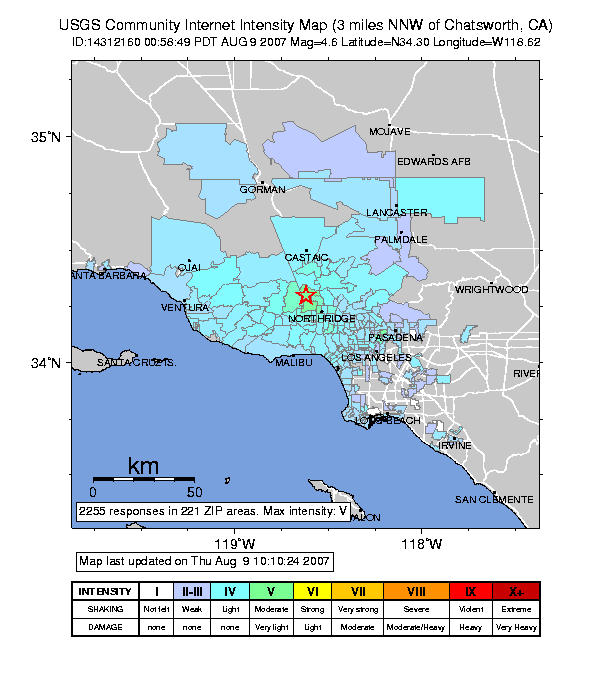 About twenty minutes after writing the previous post, I felt my first earthquake out here in L.A. It had a magnitude of 4.6, with an epicenter near Chatsworth; it struck at 12:58am local time; and it's being referred to as "Event 14312160." Check out the official shake map of that experience. Our apartment trembled for a few seconds – as if a large, but totally silent, truck was rumbling by – before the building, which is on stilts, sort of jolted. That was it.
 [Image: Bolivia's salt hotel; photographed by Jose Luis Quintana/Reuters]. [Image: Bolivia's salt hotel; photographed by Jose Luis Quintana/Reuters].Ten years ago this month, I took a Polish-language tour of a salt mine outside Kraków – because, at the bottom of the mine, there was a church made from salt. It was carved from the walls of the mine itself. That increasingly distant and somewhat surreal experience – I don't speak a word of Polish, and everyone on the tour was from Austria – came to mind when I read about a new salt hotel in Bolivia. It's a hotel made from salt. According to National Geographic, the hotel is "constructed solely of salt blocks on the white plains of the Salar de Uyuni in southwestern Bolivia." The Salar de Uyuni is the world's largest salt desert. Until tourists began visiting it, however, "the only inhabitants of the chilly, harsh region were salt miners, who still extract 25,000 tons of salt annually from the 10 billion tons available." I know at least this writer is curious if they'll someday build an exact, to-scale replica of the city of Edinburgh: shining there, in the Andean heat, with white cubic walls, the city will then be shaved down – bit by bit, brick by brick – and drunk with shots of tequila. You can salt your chips with it. Or perhaps architectural enthusiasts will forego the Snow Show... and buy tickets to Bolivia, instead: the Salt Show. Mineral pavilions designed by Zaha Hadid. Sodium towers by OMA. (Via Super Colossal and Boing Boing).
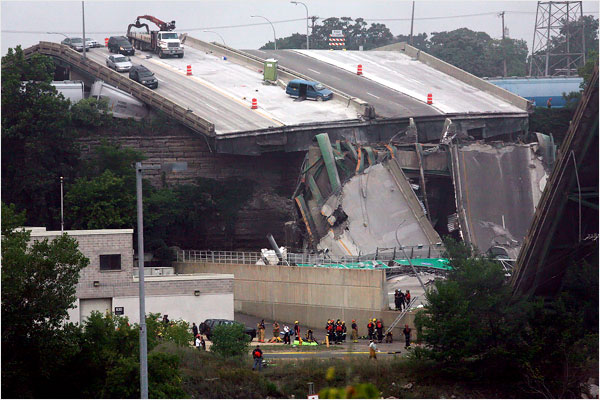 [Image: Photo by Allen Brisson-Smith for The New York Times]. [Image: Photo by Allen Brisson-Smith for The New York Times].After yesterday's bridge collapse in Minneapolis – a bridge my sister and her family drove across everyday – the decaying state of American infrastructure is becoming all the more apparent. Last month it was an exploding steam pipe in Manhattan; a few years ago it was the levees of southern Louisiana; and anyone who drives a car in the U.S. has probably noticed that the roads here are not particularly well-kept. The sheer number of potholes in the city of Philadelphia, for instance, was enough to convince me, only half-jokingly, that if the city was not going to spend any money fixing the streets, then they should at least help underwrite repair bills for all the broken axles, blown suspensions, and sometimes major fender benders caused by the city's rather obvious display of custodial irresponsibility. 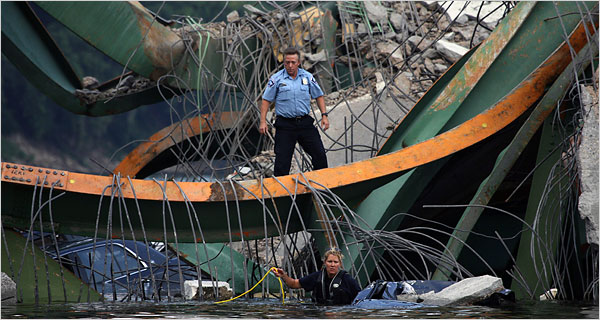 [Image: Photo by Jeff Wheeler/The Star Tribune/AP; via The Guardian]. [Image: Photo by Jeff Wheeler/The Star Tribune/AP; via The Guardian].In any case, The New York Times opines today that these system-wide failures "are an indication that this country is not investing enough in keeping its vital infrastructure in good repair." Transportation officials know many of the nation’s 600,000 bridges are in need of repair or replacement. About one in eight has been deemed "structurally deficient," a term that typically means a component of the bridge's structure has been rated poor or worse, but does not necessarily warn of imminent collapse.
Most deficient bridges, which included the span of Interstate 35W over the Mississippi River in Minneapolis, remain open to traffic. Worse, 13.6 percent of U.S. bridges – i.e. more than 81,000 bridges – are "functionally obsolete." 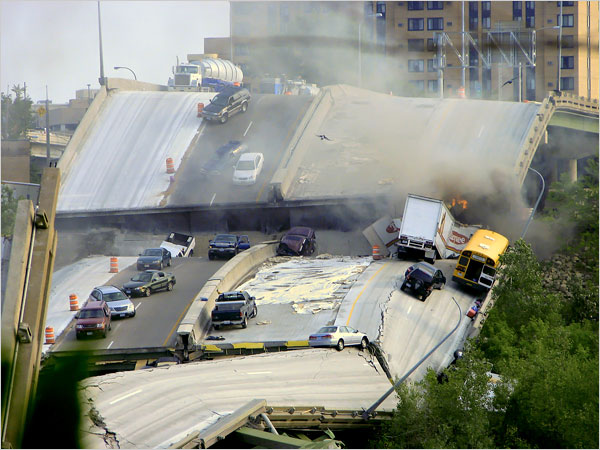 [Image: Photo by Heather Munro/The Star Tribune/AP; via The Guardian]. [Image: Photo by Heather Munro/The Star Tribune/AP; via The Guardian].Ironically, only six days ago the Federal Highway Administration announced a $5.3 million grant program meant to stimulate and reward innovative research in bridge repair and design. "Nearly $5.3 million in grants will be awarded to bridge projects in 25 states to help develop new technologies to speed bridge construction and make them safer," we read on the FHA website. None of those grants will be going to Minnesota. 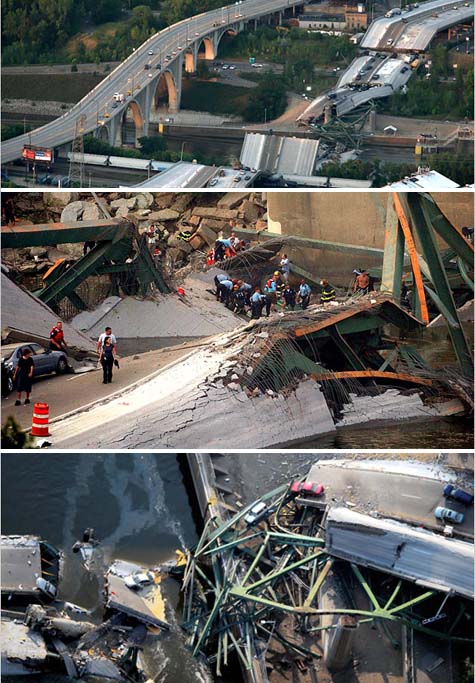 [Images: Photos courtesy of The New York Times]. [Images: Photos courtesy of The New York Times].It's interesting to point out, then, that the Federal Highway Administration's annual budget appears to be hovering around $35-40 billion a year – and, while I'm on the subject, annual government subsidies for Amtrak come in at slightly more than $1 billion. That's $1 billion every year to help commuter train lines run. To use but one financial reference point, the U.S. government is spending $12 billion per month in Iraq – billions and billions of dollars of which have literally been lost. Infrastructure is patriotic. There is no reason to question the political loyalties of those who would advocate spending taxpayer dollars on national infrastructure – from highway bridges and railway lines to steam pipes, levees, electrical lines, and subway tunnels – instead of on military adventures abroad. Four months of foreign war would be enough to double the annual budget for the Federal Highway Administration – if that's what one would choose to spend the money on – taking care of quite a few of those 81,000+ bridges which are still open to traffic and yet "functionally obsolete." Perhaps the best way to be "pro-American" these days is to lobby for modern, safe, and trustworthy infrastructure – and the economic efficiencies to which that domestic investment would lead. At the risk of promoting a kind of isolationist infrastructural nationalism, I'd say that urban design and engineering is a sadly under-appreciated – yet incredibly exciting – way to serve your country.
 Future Australians perplexed by the design of their cities might have ants to blame: "The movement of ants could help solve traffic jams and crowd congestion, Australian scientists say, and the findings could be used in future town planning systems." Indeed, we're told, "Humans could learn from ants about how to deal with... exiting large venues after concerts or sporting events." Eat grass, for instance, and dig lots of orderly holes. Apparently, whilst being studied, "ants moved in an orderly fashion, and never seemed to panic, even when there was danger or congestion." In any case: do ants offer interesting analogies and parallels for fields such as robotics? I'm sure they do. But I have to admit I'm a bit skeptical when it comes to using ant behavior as a model for urban design; something tells me ants act like ants because they're ants, and that to rebuild our cities and streets so that the built environment responds best to those of us who might act like ants might be artistically fascinating – but perhaps a little foolish. (Thanks, Steve! Previously on BLDGBLOG: Tracking Ants and Nest-casting. See also inhuman urbanism, animal urbanism, and simian urbanism).
 The novels of Patrick McGrath are often described as Gothic. They unfold across foggy landscapes and rolling moors, on marshes dotted with isolated houses and dead trees. There is a lot of rain. McGrath's characters are frequently deformed, crippled, mad, or somehow undefined, both psychologically and sexually; they are sinister, if naive, and quietly aggressive, weaving conspiratorial plots around one another with a tightness and an intricacy, and a psychological intensity, till something dreadful occurs – and the book then lurches on to its brutal and unhappy ending. Amidst tropical swamps and London graveyards, crumbling barns and basements, operating theaters and unused bedrooms, we find incest, murder, and suicide – as well as the creeping, subterranean shadows of mold and rot. But it is the settings, and not the plots, of Patrick McGrath's novels that led me to speak with him for BLDGBLOG. For those brackish marshes and dust-filled hospital wards are extraordinarily well-described; indeed, McGrath's eye is intimidating in its detail, supplying information across the senses, giving us the taste, smell, and sound of his fictional worlds, in beautifully crafted sentences. His landscapes are precise, vivid, and worth re-reading.  A question often asked on this website is: what do novelists, artists, and filmmakers want from landscape and the built environment? More specifically, how can architecture assist a writer as he or she constructs a novel's storyline? Are certain types of buildings more conducive to one kind of plot than to another? And what about landscape? How does landscape lend itself to literary effect – and could landscape architects actually learn something about the drama of designed space by turning to a novel instead of to a work of theory? To the work of Patrick McGrath, for instance? In the following interview, Patrick McGrath talks to BLDGBLOG about Romanticism, the Sublime, and the origins of Gothic literature, from Mary Shelley's Alpine wastes to the forests of Bram Stoker, by way of Edgar Allan Poe and the frozen seas of the Antarctic. We discuss David Lynch, The Sheltering Sky, the architecture of psychiatric institutions – where cell doors always open outward – and the spectacle of unfinished castles soaked with rain on the British moors. We pass through mountains, abbeys, and malarial swamplands, referring to Joseph Conrad, amateur paleontology, and the featureless voids of the Sahara. We spoke by telephone.  [Image: Novelist Patrick McGrath].• • •BLDGBLOG [Image: Novelist Patrick McGrath].• • •BLDGBLOG: First, on the most basic level, could you talk about what makes a landscape "Gothic"? Is it the weather, the landforms, the isolation, the plantlife…? Further, in your own work, what is it, on a psychological level, that unites, say, the crooked and leafless trees of the British moors with the coastal swamps of Honduras? Patrick McGrath: Not an easy question to answer! As you point out, a landscape could be tropical – or it could be Arctic, and it could still have those qualities that we might consider Gothic. It’s hard to know just what these landscapes have in common. I suppose we have to go back to the origins of Romanticism, and to Edmund Burke's book on the Sublime, and look at his notions of the horrid and the terrible. There were landscapes that emotionally aroused the people of that time – but because of their what? Their magnificence in some way. The sheer scope and grandeur of the high mountains – the Alps which Mary Shelley described very powerfully in Frankenstein – or the eastern European landscape in Bram Stoker's Dracula: the loneliness and the remoteness of those mountains, the density of the forests, the fact that there are very few human beings there. Nature dwarfs humanity in such landscapes. And that will arouse the sense of awe that is made particularly dramatic use of in Romantic and Gothic literature. Then, at the other end of the scale, we have a tropical landscape such as Conrad’s Congo in Heart of Darkness where it’s almost the reverse: it’s the constrictiveness and the fecundity of nature, the way it presses in on all sides. Everything is decaying. And decay, of course, is a central concept in the Gothic. So when you have tropical vegetation you do have a sense of ooze and rot – of swampiness. BLDGBLOG: You mentioned that certain landscapes might have been "emotionally arousing" for the people of that era – but this implies that what makes a landscape emotionally arousing will change from generation to generation. If that’s the case, might something altogether different be considered Gothic or Romantic today? Have you noticed a kind of historical shift in the types of landscape that fit into the Gothic canon? McGrath: My first thought is: not so much of landscape – but let’s say in the view of the city. My second novel, Spider, was inspired by a book of photos by Bill Brandt. He captured the seedy, ill-lit character of the East End of London of the 1930s in such powerfully human character – illicit liaisons on wet cobbled streets, toothy barmaids in grotty pubs, pulling pints for sardonic men in cloth caps – that I was at once inspired to find a story there. But I do think the Victorian slum – the dark, rather shadowy streets that have a sort of sinister and rather threatening feel to them – could be replaced by the blandness of a suburb. I’m thinking of what David Lynch did in Blue Velvet, with a scene of apparent utter normality. Think of the opening scene where a man is watering his garden and everything seems, well, perfect in that neat and orderly suburban way and yet his camera then goes beneath the grass and we see all sorts of forms of life that are slimy and grotesque and that aren’t apparent in that hygienic world above. So there may be something in that: the suburb as the most Gothic of sites. Think of the work, say, of Gregory Crewdson. BLDGBLOG: That raises the question of what sorts of architecture pop up most frequently in Gothic literature: usually English manor houses, church ruins, forgotten attics and so on. Why are certain types of buildings more conducive to one type of storyline and not others? McGrath: I think you’d have to say that there are two questions here. There’s the conventional, stereotypical Gothic site which tends to be a lonely house high on a hill, probably Victorian, with turrets and the possibility of secret passageways and cellars and attics – places of obscurity, places where the past somehow resides. You know, houses of secrets. These sites, in turn, would have grown out of the more traditional Gothic architectures – basically the ruins of monasteries and abbeys and convents and such, which dotted the British landscape in the 18th century, after the Reformation. Those first aroused the taste for ruins, and that was the origin of the Gothic. That would be basically a medieval architecture – in ruins, as I say, because of what Henry VIII did to the English church in the 16th century. So those were the places where people like Horace Walpole set their fiction, because the buildings were in such a state of decrepitude. I think anything that sort of relates to these large, broken down, dilapidated structures would arouse the Gothic effect.   [Images: The Abbey in the Oakwood, 1809-10, and Cloister Cemetery in the Snow, 1817-19, by Caspar David Friedrich].BLDGBLOG [Images: The Abbey in the Oakwood, 1809-10, and Cloister Cemetery in the Snow, 1817-19, by Caspar David Friedrich].BLDGBLOG: Interestingly, though, in the work of J.G. Ballard, you get the same sort of psychological atmosphere – of perversion, violence, and dread – from a totally different kind of built environment: instead of crumbling manor houses, you have corporate office parks in the south of France, or even British shopping malls. McGrath: Absolutely – and that was going to be the second part of my answer. There is the old Gothic, which does have a very definite architectural style that comes out of the structures of the Middle Ages, as these became ruins and gave off a sense of ghostliness and evil and menace. But then there is what you might call, I don’t know, a new Gothic, where the particular trappings of the old Gothic, the particular stylistic characteristics, are not necessary to produce the same sorts of effects – the feelings of dread, constriction, obscurity, transgression. You can get those from inner city projects, for example, or even a little neat rowhouse. There was an early Ian McEwan novel, The Cement Garden, where all sorts of perverse wickedness was going on but in a very sort of unmemorable little house, in a street of very similar houses, none of which would particularly smack of evil. Although I did notice, when I was re-reading it, that he uses a little crenellation detail in the architecture of one of these absolutely anonymous little houses. He’s just touching-in this faint hint of the Gothic – as though to say: this is a child of something out of Ann Radcliffe, some decaying monastery in which an aristocrat pursues a maiden in the depths of the night. 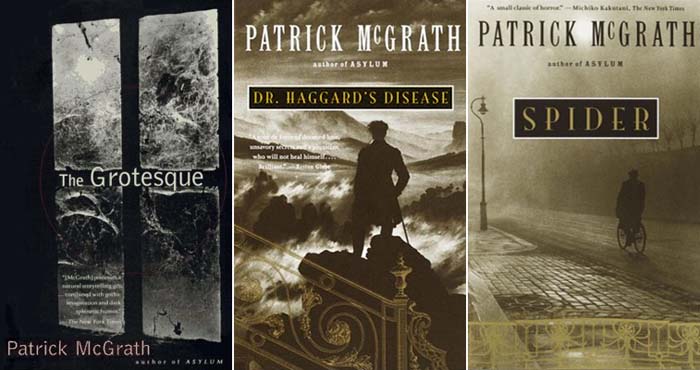 BLDGBLOG BLDGBLOG: I’m curious if there are any real buildings that you have in mind when you’re describing places like Drogo Hall or Crook Manor. Put another way, could someone ever do a kind of Patrick McGrathian architectural tour, or heritage walk, visiting sites that have inspired your fiction? Where would that tour take them? McGrath: [ laughs] Good question. I don’t quite know where I get them from. In part from the imagination, in part from books, books I’ve got around the place with photographs or paintings of buildings, some of which I’ve observed and remembered. There’s a house called Crook in my first novel, The Grotesque. I found a lovely little book in a second-hand bookstore in New York, called The Manor Houses of England, and I simply leafed through it, picking up details here and there – not only architectural details, but verbal details. The way that aspects of architecture are described – the sorts of terms that are used – can be as much a part of the creation of a building in fiction as a clear, purely visual picture in your mind. You catch a nice phrase that’s used to describe, I don’t know, a Jacobean staircase or a particular piece of detailing or masonry – and you fling it in because it sounds good, rather than just because it evokes a particular image. But I don’t think there’s a pattern. They’re usually curious amalgams that I put together in my imagination. BLDGBLOG: I noticed one day that there is a real Castle Drogo. Architecturally, how much of that was an influence on your descriptions of Drogo Hall? Or did you just use the name? McGrath: It was basically just the name. Castle Drogo’s somewhere down in the West Country, I can’t remember where – I think it looks over Dartmoor. It was built in, I think, the early twentieth century by some rich industrialist, as I remember, who wanted to have a main building with two wings. But then his son was killed in WWI, and he’d only built one wing of the castle. He grew so despondent that he never built the second wing. All the life had gone out of him. So it’s an incomplete structure. It was also essentially an ersatz thing – it wasn’t a proper castle. It was an Edwardian idea of a castle – of which there are many in Britain, of course. But it was the name; the name was very powerful: Drogo. So I pinched the name and gave it to a building that I largely invented out on the Lambeth Marshes. And, again, the Lambeth Marshes as I describe them don’t really have any resemblance to the Lambeth Marshes as they existed in the 18th century. I mean, I sort of put a Dartmoor on the south of the Thames – and I don’t think it was like that! [ laughter] BLDGBLOG: Well, it works, so... McGrath: It works – and that’s all you want. 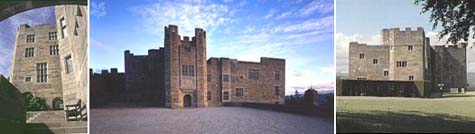 [Images: Castle Drogo].BLDGBLOG [Images: Castle Drogo].BLDGBLOG: Have you read The Emigrants by W.G. Sebald? One of the stories is partially set in an old, sprawling psychiatric hospital in the forests of New York state. Near Syracuse, I think, or maybe Ithaca. The narrator explains that his uncle once committed himself there voluntarily to undergo electroshock therapy, basically as a way to erase painful memories from some time spent in the Sahara south of Cairo. McGrath: Now, this is very, very interesting – I’ve read Sebald, but not that particular book. In fact, I’ve just finished a novel which is set in Manhattan and the last couple of chapters are set in a mental hospital in northern New York state. And I had no idea about Sebald using that location – and I didn’t really know about the Victorian institutions you described. What I did was I took an institution from northern Ontario where I worked when I first came over to North America, and it was very unlike a Victorian institution. It was sort of like a blockhouse – like a penitentiary. And so what I’ve done is I’ve sort of plonked that down in upstate New York – but I might have to rethink how I’ve done that based on what you’ve just said. But this is great to know – I’ve still got time to tear that chapter apart. BLDGBLOG: Well, some of those hospitals – these big, Gothic complexes – have actually been demolished. But in other cases, they’ve been transformed into apartments and condominiums – McGrath: Yes, that’s happening in England, too. I visited old Victorian asylums there that have outlived their usefulness and are now being converted into apartments. 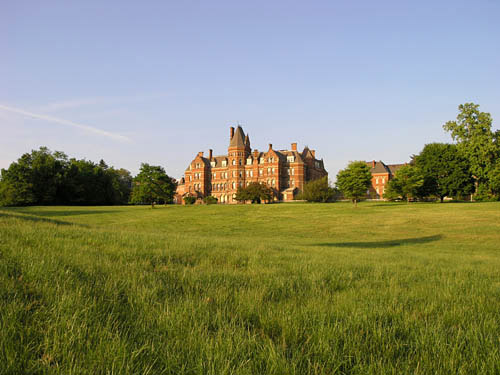 [Image: The Hudson River State Hospital, beautifully photographed by Kirkbridebuildings.com. The rest of that site – especially the other hospitals – is well worth checking out].BLDGBLOG [Image: The Hudson River State Hospital, beautifully photographed by Kirkbridebuildings.com. The rest of that site – especially the other hospitals – is well worth checking out].BLDGBLOG: Returning to the question of landscape, the natural environments in your work are extraordinarily well-described; in fact, there are parts of Asylum that strike me as literal exemplars of superb landscape description. I’d love to know more about how you work: if you actually visit specific locations, driving up to the moors or through the hills of New England, to capture your descriptions on the spot; or if you work from memory, or from imagination, or even from other books of photographs. McGrath: There have been times when I’ve gone to a place. When I went down to Belize, for instance, and saw what Belize City looks like – the shacks lurching unsteadily over the river, the mangrove swamps and so forth – that just told me, instantly, that here I had the setting of a novel. I took a lot of photos and then basically used what I’d seen. Other times, I just sort of invent it. I remember when I was writing The Grotesque, I had the Berkshire marshes in there, and I’d been out of England for many years at that point and somebody pointed out to me that, in fact, there are no marshes in Berkshire – BLDGBLOG: [ laughs] McGrath: – but by then it was too late. I needed there to be marshes and I wanted it to be Berkshire, for some reason, and so there it was: a completely nonexistent landscape had sprung to life. I don't know, I look at things and a lot of it comes from reading. I discover details that, for example, in prisons and asylums you will always have the doors opening outwards so that whoever is incarcerated behind that door won’t be able to blockade themselves inside the room. Little details like that give the character of an institution and can be very evocative on the page. 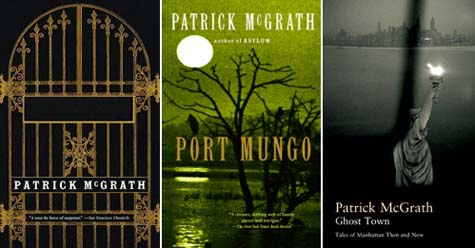 BLDGBLOG BLDGBLOG: I'm also curious about weather and climate. For instance, a wet climate – with thunderstorms, humidity, and damp – seems to play a major, arguably indispensable, role in the Gothic imagination. Your own novels illustrate this point quite well: from rain-soaked country homes to the Lambeth marshes, from coastal fishing towns to Central American swamps. But can aridity ever be Gothic? In other words, if the constant presence of moisture contributes to a malarial atmosphere of decay, mold, infestation, and disease, might there be a whole other world of psychological implications in a climate where things don't decay – where there is no mold, where bodies turn to leather and everything can be preserved? Is indefinite preservation perhaps a Gothic horror of its own? McGrath: Aridity does interest me. It’s an unusual application of the Gothic mood. You usually think of northern European or north American climates and landscapes, but that’s merely because, traditionally, that’s where these sorts of stories have been set. But I can very well imagine aridity being a place, or a site, for such a story. I think you could safely say that one of the themes of the Gothic is the sins of the father being visited upon the sons – in other words, there is no escaping the past. The past will always haunt the present. And this is certainly true of Gothic stories that are set in crumbling old houses: there's always some piece of evil that has occurred in a previous generation that will work itself out on the current generation. So that continuation – or persistence – of the past is what you’re expressing: it’s the skeleton that can’t be disposed of. But I’m trying to think if I know of a Gothic tale set in a desert, and the only thing I can come up with is... I think it's an old Erich von Stroheim movie. It might be called Greed? There's a man who has, somehow or another, wound up handcuffed to his companion – and the companion has died. This is in the quest for gold. Somehow or another their greed has got them into an impossible situation: they're handcuffed, the companion has died, and so we have a man crawling across the desert handcuffed to a corpse. It being a desert, of course, he's doomed. But that's a very powerful image of an utterly arid landscape. In the spirit of a new Gothic, one that isn't dependent on very particular types of landscape or architecture, you could certainly exploit an arid landscape in order to create a condition of extreme thirst, extreme solitude, extreme desperation – all of which would be appropriate states of mind for a Gothic story. I just can't think of many examples. BLDGBLOG: It never really occurred to me to refer to this book as "Gothic" before, but there's The Sheltering Sky by Paul Bowles – where you see people completely destroyed by the desert. The Sahara is presented as this strangely dark landscape, something that they can't comprehend culturally and they can't survive physically. McGrath: Whether you could get away with calling that Gothic, I don’t know! But, certainly, there is horror in that environment. It does have that in common with the Gothic. You can't have the Gothic without horror, and the desert is a place where, you’d think, horror is always close at hand. BLDGBLOG: Meanwhile, some of the earliest Gothic fiction was actually polar – Mary Shelley's Arctic chase in Frankenstein is an obvious example. I'm curious if glacial landscapes and frozen seas attract you? Might there someday be a kind of Arctic Port Mungo? McGrath: Well, again, in the novel that I've just finished, I wanted to take my character, when he's pretty much spiraled down as far as he can get in New York City, to a place of snow. And there are all sorts of precedents for this. Frankenstein, as you say, begins up in the Arctic Sea – and ends there. I think the final image is Frankenstein pursuing his creature across the frozen waste – a vast white landscape. There's also Poe's The Narrative of Arthur Gordon Pym, which comes to a place of great whiteness; and, almost contemporary with that, is Melville’s white whale. There is something about whiteness that is almost identical to blackness in terms of what it can evoke. I think it must be about featurelessness: the horror that comes of there being nothing there. It's a white nothing instead of a black nothing. But the absence of color would suggest a kind of emptiness, a draining of life and meaning. A void. And the Gothic is very fond of a void. And Melville was certainly onto that. I mean, you can’t help but see that the white whale is really just a blank screen onto which Ahab has projected all sorts of powerful and twisted emotions – but, in itself, it is merely a screen. Melville's possibly suggesting that all of nature is just such a blank screen, and that it is the business of humans to project meaning onto nature, that meaning is not inherent, is an idea that I think we can comfortably live with now; but, I think, in the 19th century, it was probably a great deal more threatening to God-fearing people. 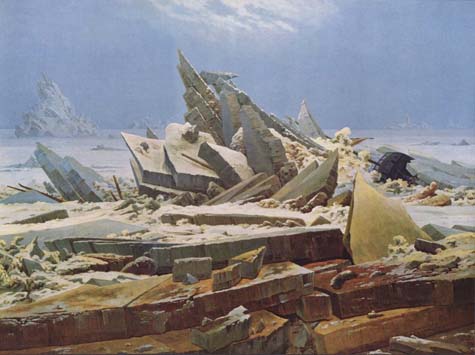 [Image: The Sea of Ice, 1824, by Caspar David Friedrich].BLDGBLOG [Image: The Sea of Ice, 1824, by Caspar David Friedrich].BLDGBLOG: One of the most striking images I've read in years is actually your character Hugo Coal, from The Grotesque, assembling his dinosaur skeleton in the family barn. I’d love to hear your thoughts about what went into that image – but also what you think about the human encounter with prehistoric monstrosity: with dinosaur bones, and marine fossils, and the utter strangeness of the earth's inhuman past. McGrath: What interested me – before I'd even thought through aspects of deep time, and what that means – was that a man could go to Africa and collect a bunch of bones and crate them up and bring them back, and then spend the rest of his life trying to see what fitted where. This may be completely implausible, in terms of paleontology, but I just liked the notion of Sir Hugo sitting there in his barn, year in, year out, trying to make a pattern, to make a structure – and continuing to get it wrong. It seemed, somehow, very much in the spirit of human endeavors to discover the truth, or to figure out how nature works – or even, within that book, to get an answer to the mystery of who killed Sidney. It was to do with the fallibility of knowledge that was contained within this enterprise of getting the bones to fit – and they won't! [ laughs] There's always a bit left over, or something that won't go where it’s supposed to go. So that was the aspect, the epistemological aspect, of reconstructing a skeleton that first fascinated me. Then there was the notion of this thing coming from deep in the past and being now extinct – from so deep in the past that it no longer had any place on this earth – and the suggestion that Sir Hugo, in a sense, was the same. He, too, was a dinosaur; his day, as a representative of a certain social class, was past. But the first impulse that I had was that this was a carnivorous creature. This wasn't a gentle herbivore Hugo's got there. This was a creature of enormous violence and absolute rapacity, capable of tearing its prey to pieces, and I wanted to suggest that those sorts of implicit violent energies were now swirling about this old country house. BLDGBLOG: In some ways, though, it seems like the contemplation of the earth's biological past lends itself well to the Gothic mood – but contemplating, say, the earth's geological past just doesn't have the same psychological impact. For some reason, rocks just aren't very Gothic. McGrath: Well, I remember the way that Conrad handles the river in Heart of Darkness: he speaks of the journey that Marlow takes to get to Kurtz as being a journey through, or deeper into, the geological history of Africa. I forget how he does it, but he gives you the sense that, as the boat moves up the river, it is also descending through eons of time. So there is almost a sense of a geological regression occurring as Marlow moves toward a man who has committed an act of enormous moral regression. Everything is about a movement downwards in that book. I’d say that he employs geological descent to mirror a moral descent. BLDGBLOG: Of course, there's also Hugo Coal’s surname: coal, a geological product. McGrath: There you are. Absolutely. That was no accident. Again, I'm referring to deep layers of what once had been wood, and that now, through the operation of time and pressure, is something quite different. BLDGBLOG: Finally, I'd like to ask you about islands. You're from England, with a home in Manhattan, and you’ve lived on "a remote island in the north Pacific." Interestingly, though, your work doesn't include a lot of islands – indeed, there are very few scenes at sea. Do the Gothic possibilities of islands, or archipelagos, have any literary interest for you? McGrath: Well, that's true. I don't know why that should be. I've put people by the water often enough – a lot of my people seem to stand in high places gazing out to sea – but the notion of an island as a... I suppose the island gives you the possibility of a closed community – and that's always a good site to play out a story in. You can just say that the world doesn't extend beyond the borders I've imposed upon it. I suppose the use of a village is a sort of island. The last book I’ve done is set in Manhattan almost exclusively, but... I've never sort of literally done an island. I think every novelist – unless you're Dickens, maybe, where you just want to give a great sweep of an entire society – finds a way of creating islands, or social islands, anyway. The family is a sort of island. A prison, an asylum, is a sort of island. A town can be a sort of island. I mean, every novel has to limit its scope geographically and socially, so I suppose we create islands – but I've never particularly been drawn to an island itself. Though I do have a novel somewhere in the back of my head set on an island in the Mediterranean. I suppose the answer is: I don't see the need for an island in itself, when the only point to an island would seem to be to draw a circle around a community. Unless it was the notion of being cut-off... That would be a good reason to make an island. You know, where the weather closes in and your people have no way of escape. I can see that being a way you might want to use an island. But I just haven't felt the need yet. 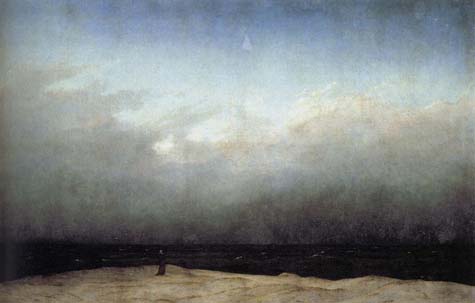 [Image: Monk by the Sea, 1809, by Caspar David Friedrich].BLDGBLOG [Image: Monk by the Sea, 1809, by Caspar David Friedrich].BLDGBLOG: As I mentioned, your bio refers to a "remote island in the north Pacific." I'm just wondering where exactly that was? McGrath: There's a group of islands called the Queen Charlottes. They're off the northwest coast of British Columbia. If you were to find Prince Rupert on the map, you would then just go due west about 80 miles, and they're just south of the Alaskan panhandle. There are two main islands: Moresby and Graham. Moresby is uninhabited and Graham has, oh, two or three little towns. That's where I lived a few years. I was a schoolteacher back in those days, and I'd been living in Vancouver, and I wanted to get out of the city, basically. So I got a job teaching there, and, while I was there, I basically gave up teaching and built a cabin and declared myself a writer. That was the beginning. • • •BLDGBLOG would like to thank Patrick McGrath for taking the time to have this conversation – which he and I both hope to continue in a few months' time: so watch out for another interview with Patrick McGrath here on BLDGBLOG, to be posted, I hope, this winter. Meanwhile, Asylum, The Grotesque, and Spider are all great places to start, if you're looking for an introduction to Patrick McGrath's work. Spider, of course, was recently filmed by David Cronenberg. A new novel, meanwhile, called Trauma, is due out in April 2008. Finally, this PDF contains a much longer, and older, interview with McGrath (in which he describes the grotesque as "things beginning to merge, things becoming undifferentiated" – the grotesque is a "breakdown, in every dimension that I could imagine, in the organic, in the social, in the sexual, in the natural"). Briefly, then, it's interesting to point out that one of the manifestos mentioned in the previous post discusses the grotesque in terms of monstrosity, beauty, and architecture.
|
|